November 17, 2026
fomo trading: fomo meaning in trading – How to Stop Chasing Price
FOMO trading means making or considering trades because of a fear of missing out on a market move. It often appears when traders chase prices after a missed opportunity, enter without a valid setup, or change their risk rules to avoid feeling left behind. The key question is not whether a market is moving quickly, but whether the trade still fits the plan.
A rising EUR/USD chart, a successful trade shared online, or a breakout you failed to enter can create a sense of urgency. But urgency is not a trading strategy. Before acting, you need to know whether a valid opportunity still exists and what has changed since the original entry.
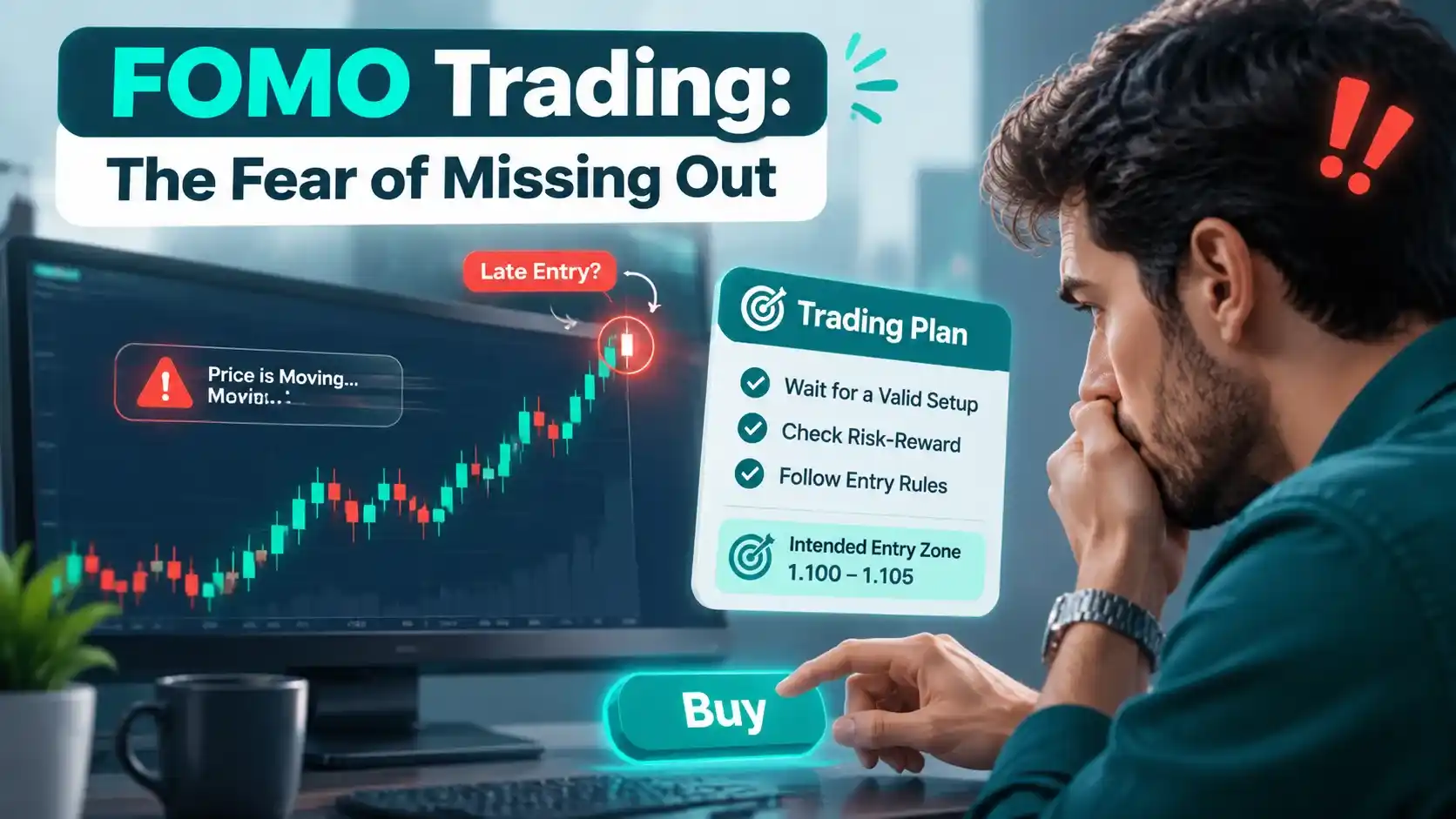
In this guide, you will learn what fear of missing out in trading actually means, how to distinguish a valid momentum trade from impulsive price chasing, and how to evaluate a late entry with a practical FOMO Entry Drift Audit.
Key Takeaways
- FOMO is an emotion, not an entry signal. Feeling urgency does not establish whether a trade is valid.
- A strong market move is not automatically a bad entry. Planned momentum and breakout trades can be legitimate.
- Chasing a price can change your risk. A later entry may leave less potential reward relative to a fixed stop-loss.
- Missing a trade is not a realized loss. A move that happened without you does not create an obligation to enter.
- A trading journal can support a better review. Compare original plans, actual actions, rule compliance, and self-reported emotional triggers.
What Is FOMO Trading?
FOMO stands for fear of missing out. In financial trading, it describes the feeling that an attractive market opportunity is disappearing and that you must act before it is too late.
The feeling often becomes more intense when prices move rapidly, other traders report gains, or a previously identified setup has already passed.
For a trader, the problem is not simply experiencing FOMO. The problem arises when the feeling changes the trading decision.
For example, a trader might:
- Enter a position after the predefined entry zone has expired.
- Skip a required confirmation because the market appears to be moving away.
- Increase position size to compensate for entering later than planned.
- Take a trade mainly because other traders are celebrating profits.
- Ignore a risk restriction because the opportunity feels unusually important.
FOMO is a possible emotional influence behind these actions, but it cannot be reliably diagnosed from price movement or transaction history alone.
Quick answer: FOMO trading becomes a practical execution problem when the fear of missing an opportunity leads a trader to abandon predefined entry criteria, position-sizing rules, or risk limits. The appropriate response is to evaluate the current setup independently—not to chase the movement.
What Does FOMO Mean in Forex Trading?
In Forex trading, FOMO may occur when a currency pair moves strongly before a trader enters.
Imagine that EUR/USD rises through a price level you were watching. You had planned to enter only after a particular confirmation, but the market moves quickly without giving you the entry you expected.
You may begin thinking, "If I do not enter now, I will miss the entire move."
That thought is an example of trading FOMO. Whether the next trade is actually inappropriate depends on the current market conditions and the rules of your strategy.
A properly defined momentum strategy might still identify a valid new opportunity. Conversely, the original trade may already be invalid.
The difference matters in Forex, Futures, CFDs, and stock trading alike.
Signs and Causes of FOMO Trading
Seven Warning Signs of FOMO-Driven Decisions
- You enter after your planned setup has expired. The market has moved away, but you enter anyway without a new qualifying signal.
- You feel pressured by the speed of the market. Urgency becomes more important than checking your entry conditions.
- You change your position size impulsively. You increase exposure because the trade feels like an opportunity you cannot afford to miss.
- You react strongly to other traders' profits. A screenshot, trading group, or social-media post becomes the main reason to enter.
- You overlook the remaining potential reward. Your entry moves closer to the intended target while the planned invalidation level remains far away.
- You repeatedly abandon the checklist. Established conditions suddenly seem unnecessary once the market starts moving.
- You regret missed moves more than invalid trades. The discomfort of staying out begins to dominate your decision-making.
These signs are prompts for investigation, not proof that every affected trade was caused by fear or that the trader has a psychological disorder.
Why Does FOMO Happen?
Rapid Price Movement
Fast-moving candles can create a sense that a decision must be made immediately. That urgency may encourage entries before the trader has checked whether the current price still satisfies the strategy.
Other Traders' Success
Seeing profit screenshots, confident forecasts, or enthusiastic trading discussions can make staying out of the market feel like falling behind.
Regret After a Missed Setup
Missing an earlier move can make the next entry feel emotionally necessary, even when the original opportunity is no longer available.
Unclear Entry Boundaries
If a trading plan does not define where a setup becomes invalid, it may be difficult to distinguish a legitimate later entry from an emotional chase.
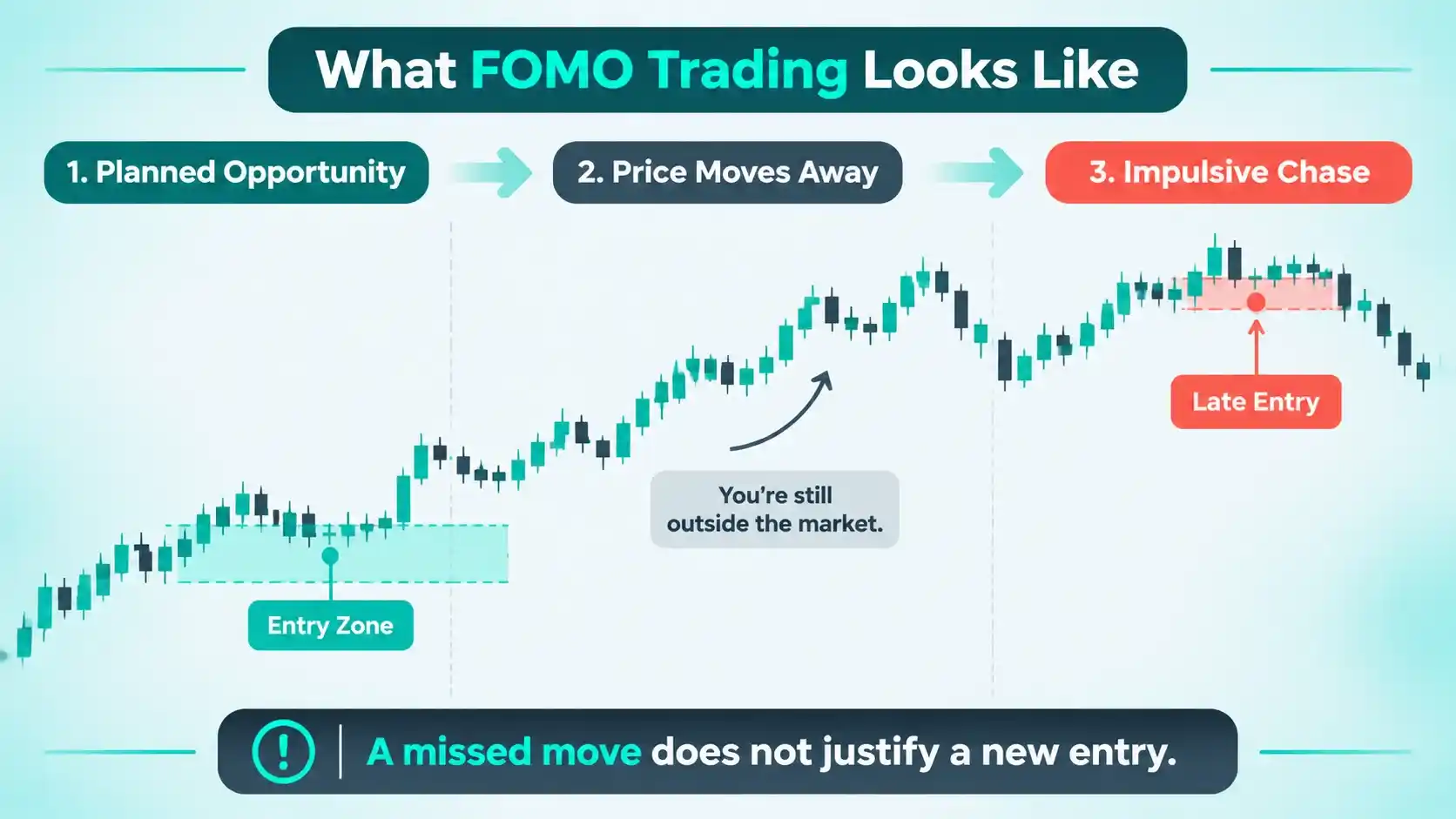
How FOMO Appears in Trading Decisions: Three Examples
The following examples are fictional. They illustrate decision-making patterns rather than actual customer trades or historical market events.
Example 1: The Forex Trader Who Chases EUR/USD
A day trader identifies a potential EUR/USD long entry near 1.1050, provided all predefined entry conditions are met.
The trader hesitates and misses the original entry. Price subsequently reaches 1.1080.
Instead of checking for a new setup, the trader enters because they fear missing the move toward the original profit target.
The entry is now 30 pips higher, but the original stop-loss and target remain unchanged.
The decision may represent a FOMO-driven rule violation if the initial setup has expired and the strategy provides no independent reason to enter at 1.1080.
The later section on entry drift calculates the consequences of this change.
Example 2: A Valid Momentum Trade After a Strong Move
A Futures trader follows a strategy that permits continuation entries after a breakout, provided a specific pullback and confirmation sequence appears.
The market breaks higher. The trader misses the initial move but later identifies a newly formed continuation setup that satisfies the strategy.
The trader checks the current invalidation level, position risk, and other restrictions before entering.
Although the trade takes place after a strong price movement, the entry may still be fully compliant.
The timing alone does not make it a FOMO trade.
Example 3: A Trade Triggered by Social Media
A trader sees a screenshot showing a large gain from a stock or currency trade.
The post creates excitement and a fear that others are capturing an opportunity while the trader is missing it.
The trader considers opening a position immediately, without checking the original signal, current price, or position risk.
In this situation, the social-media post is an emotional trigger, not a complete trading plan.
A more structured response is to assess the instrument independently, determine whether a valid setup exists, and apply the normal risk restrictions.
FINRA advises investors to evaluate social-media investment information carefully and to recognize when excitement or fear of missing out may be influencing a decision. Read FINRA's investor guidance.
What About Increasing Position Size?
FOMO does not always change the entry price. It can also affect the amount of risk taken.
Suppose a trader's plan allows a maximum risk of $100 on a particular trade. After seeing an exciting breakout, the trader opens a position with an intended loss at the stop of $250 instead.
The hypothetical position exceeds the original risk budget by $150, or 150%.
That is a risk-rule violation regardless of whether the trade ultimately wins or loses.
The key distinction: Feeling FOMO does not automatically make a trade invalid. The meaningful question is whether the feeling caused a departure from the strategy or risk rules.
Valid Momentum Trading vs. Emotional Price Chasing
One of the most common misconceptions in trading psychology is that entering after a strong price movement is automatically a mistake.
That is not necessarily true.
Some legitimate trading strategies are designed around breakouts, momentum, and trend continuation. These approaches may deliberately enter after the market has already moved in one direction.
The distinguishing factor is whether the entry meets a predefined strategy with appropriate risk controls.
| Situation | Decision Context | Review Interpretation |
|---|---|---|
| Planned breakout entry | Breakout and confirmation meet predefined rules. | Potentially valid if timing and risk restrictions are satisfied. |
| New momentum continuation | A new independently eligible setup forms after an earlier move. | Can be compliant even though the entry occurs later. |
| Expired entry chased | The original entry zone is invalid, with no new qualifying setup. | Off-plan execution; investigate possible FOMO influence. |
| Opportunity correctly skipped | Entry conditions or risk requirements are no longer satisfied. | Appropriate restraint, not a missed obligation to trade. |
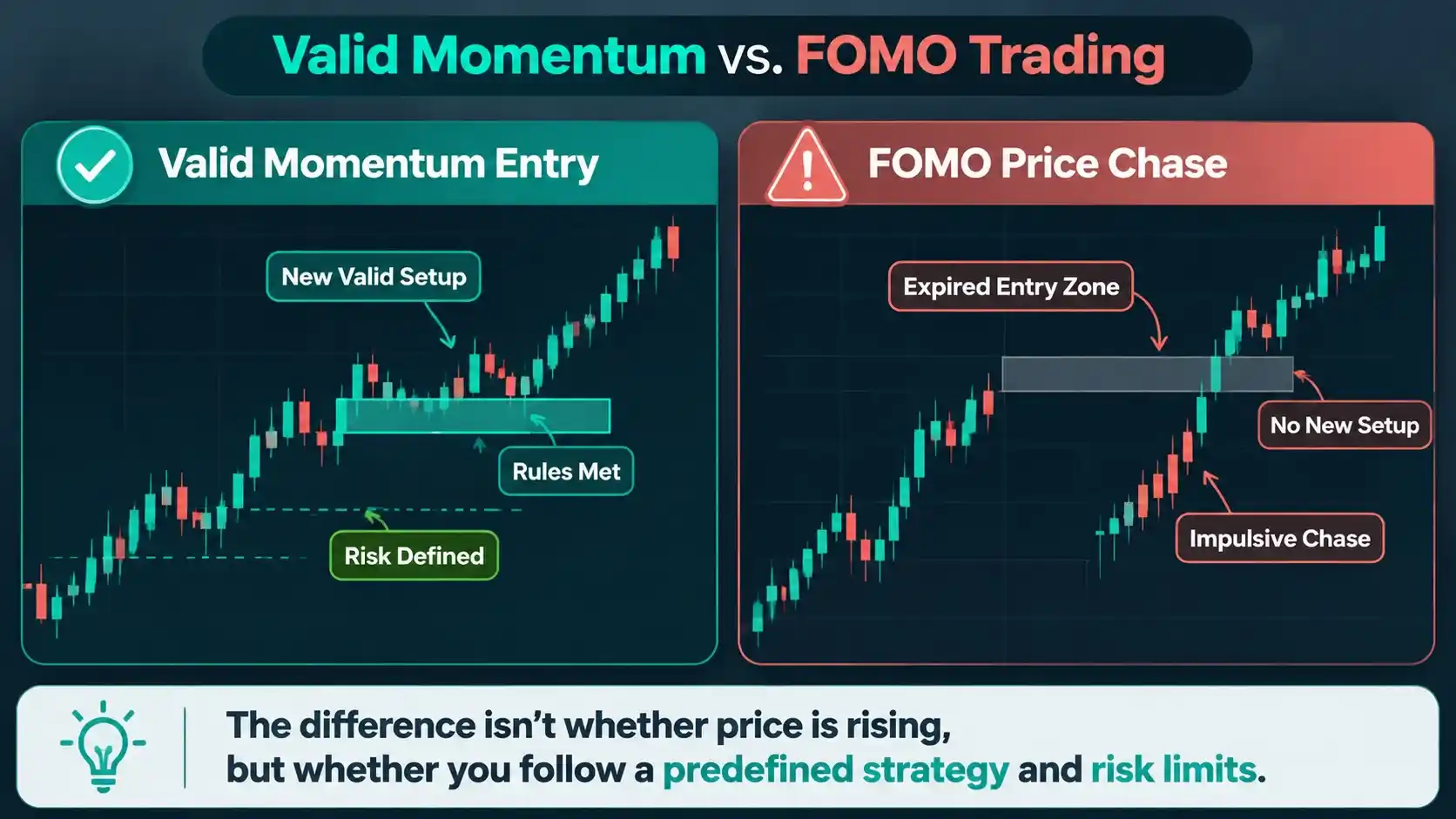
Three Questions That Help Distinguish the Two
- Was the current setup defined before the decision? A trader should be able to identify the strategy that permits the entry.
- Are the entry and invalidation rules still satisfied? A strong move does not automatically preserve the original opportunity.
- Is the risk acceptable at the actual price? A valid technical pattern can still be unsuitable if the required position risk exceeds the plan.
The objective is not to avoid every fast-moving market. It is to avoid turning a missed opportunity into an unplanned trade.
The FOMO Entry Drift Audit: How Chasing Price Changes Your Trade
A useful way to investigate FOMO is to compare the trade you originally planned with the trade you actually considered or executed.
This article uses the term FOMO Entry Drift Audit for that educational comparison.
The method focuses on a specific question:
What changed when the trader entered later than originally planned?
A Hypothetical EUR/USD Example
Imagine a trader planning a EUR/USD long position.
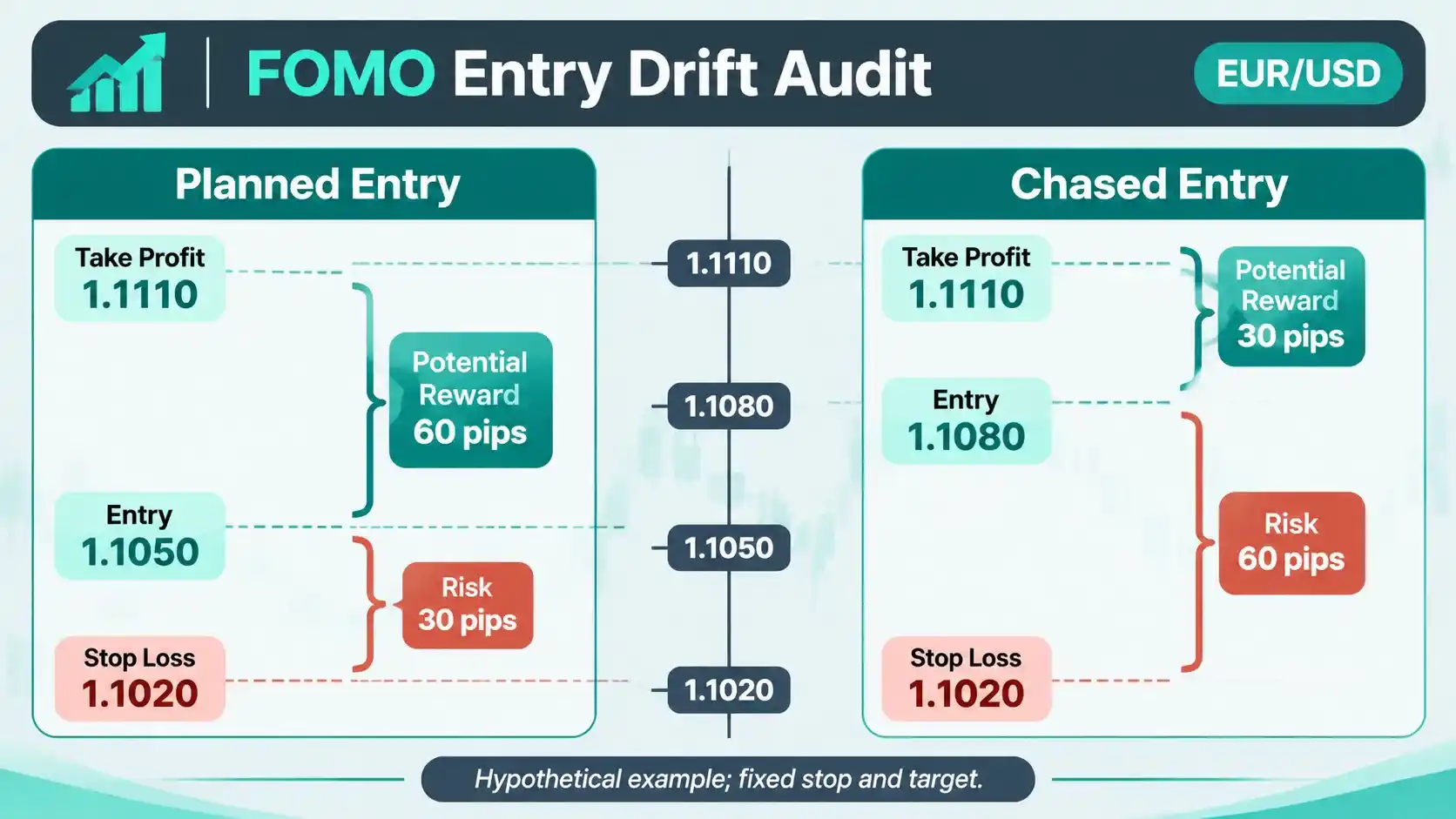
The original entry is 1.1050, the stop-loss is 1.1020, and the profit target is 1.1110.
The trader misses the initial entry and later considers entering at 1.1080.
To isolate the effect of the entry change, the stop-loss and target are intentionally kept the same.
| Measure | Planned Entry | Later Entry |
|---|---|---|
| Trade direction | Long | Long |
| Entry price | 1.1050 | 1.1080 |
| Stop-loss | 1.1020 | 1.1020 |
| Take-profit | 1.1110 | 1.1110 |
| Distance to stop | 30 pips | 60 pips |
| Distance to target | 60 pips | 30 pips |
| Potential reward-to-risk | 2:1 | 0.5:1 |
Step 1: Calculate the Original Risk and Reward
In this simplified EUR/USD example, one pip is 0.0001.
For the planned long entry at 1.1050:
Before transaction costs, the hypothetical planned trade offers 60 pips of potential reward for 30 pips of distance to the stop-loss.
Step 2: Calculate the Later Entry
After the trader considers entering at 1.1080:
The entry is now 30 pips higher. With the same stop-loss and target, the potential reward distance is cut in half while the risk distance doubles.
Step 3: Consider Position Size and Monetary Risk
The pip-distance comparison is not the same as a complete account-risk calculation.
At unchanged position size and pip value, increasing the distance to the stop from 30 to 60 pips doubles the potential loss at the stop, before costs and execution differences.
If the trader instead maintains a fixed monetary risk budget, the position size would need to be reduced proportionally in this simplified example.
For instance, a position size that is appropriate for a 30-pip stop would need to be approximately halved for a 60-pip stop to maintain the same planned monetary loss, assuming the pip value scales proportionally with position size.
Actual position sizing must still account for the instrument, contract specifications, currency conversion, margin rules, and execution costs.
What If the Trader Changes the Stop-Loss or Target?
Moving a stop-loss closer or extending a profit target can change the displayed reward-to-risk ratio.
But those changes are not automatically justified.
A stop-loss should reflect the strategy's actual invalidation conditions, while a target should follow a predefined and defensible exit approach.
Changing either number merely to make a late entry look attractive can conceal the original decision problem.
Important limitation: Reward-to-risk is a description of potential distances, not a prediction. A 2:1 setup is not guaranteed to win, and a 0.5:1 setup is not guaranteed to lose. The audit reveals how the proposed trade changed; it does not prove the later entry must be unprofitable.
The FOMO Pre-Trade Decision Framework
Traders facing a fast-moving market can benefit from having a decision process established before the emotional pressure appears.
The purpose of this framework is not to require a universal waiting period. It is to check whether the present opportunity meets the relevant strategy and risk conditions.
Eight Questions Before Entering a Fast-Moving Market
- Is there a valid setup right now? Identify the current strategy signal rather than relying on the excitement of the previous move.
- Are the required entry conditions still met? A setup can expire when price, timing, or other conditions change.
- Is the original entry zone still valid? If not, determine whether an entirely new opportunity has appeared.
- Where is the current invalidation level? Identify the stop location according to strategy rules, not according to the desired appearance of the risk calculation.
- What potential reward remains? Compare the current entry, target, and stop using consistent assumptions.
- Does the position fit the risk budget? Verify permitted risk, position size, and total account exposure.
- Is there an independent new setup? A missed breakout does not prevent a valid continuation trade, but the new entry must qualify on its own.
- Would I consider this trade without the previous market move or social-media excitement? This question may help identify whether urgency is replacing the actual setup criteria.
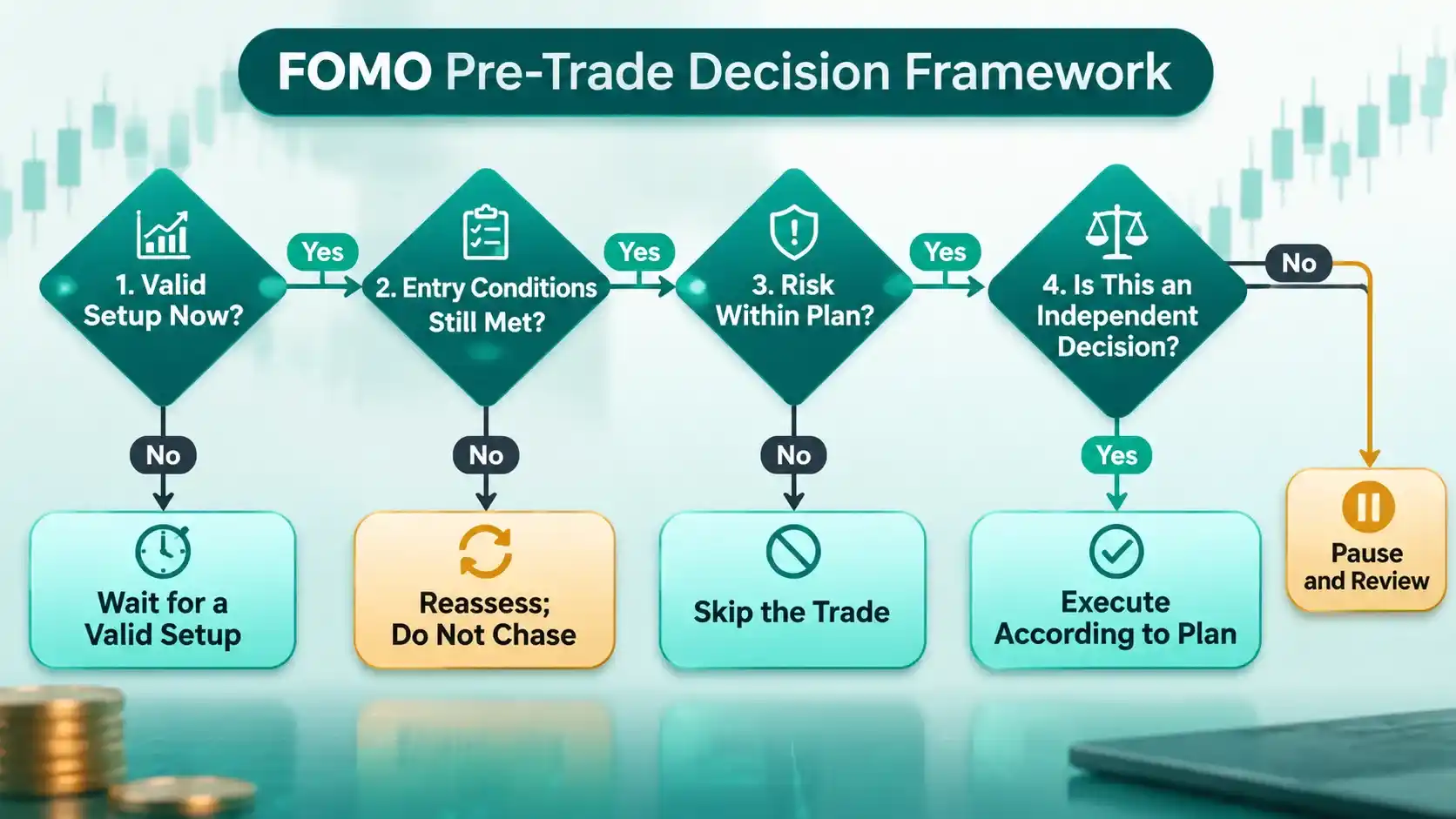
What If the Answer Is No?
If a binding entry condition fails or the risk is outside the permitted plan, the current trade should not be treated as eligible under that strategy.
This does not mean that the market cannot continue in the same direction. It means the trader has not established a valid reason to participate under the current rules.
Waiting for a new setup can be an appropriate decision even when the price continues moving without an entry.
How to Stop FOMO Trading Without Avoiding Valid Opportunities
There is no universal technique that guarantees an end to emotionally influenced trading.
A more realistic objective is to reduce the likelihood that emotional urgency changes your execution rules.
1. Define the Entry Zone and Its Expiration
Before entering a session, specify the conditions under which a planned setup is valid.
Also define how the opportunity becomes invalid. This might involve price moving beyond an approved entry area, a session ending, a required confirmation failing, or a risk restriction becoming active.
Clear boundaries reduce the temptation to reinterpret an expired setup after a market move.
2. Separate Emotional Discomfort from Rule Compliance
Feeling anxious or excited does not necessarily make a trade unsuitable.
A trader can feel uncomfortable while executing a completely valid setup. Another can feel calm while violating the plan.
Instead of judging the emotion alone, review what actually changed in the decision.
3. Calculate Risk Using the Current Entry
If the proposed entry price has changed, recalculate the risk and potential reward using that price.
Do not reuse the reward-to-risk ratio from an earlier, more favorable entry.
If the revised trade no longer satisfies the plan, that is relevant information even when the market continues moving.
4. Establish a Social-Media Decision Boundary
Treat screenshots, predictions, and trading discussions as information to evaluate rather than instructions to place an order.
Financial-market posts may omit important details such as the original entry, position size, account risk, or trades that did not work.
The SEC's investor education materials specifically caution against making investment decisions solely because of trends or recommendations from others. Read the SEC investor education article.
5. Review the Decision, Not Just the Result
A profitable off-plan trade can reinforce an unhelpful decision pattern if the trader treats the outcome as proof that the entry was justified.
Similarly, a losing trade can still have followed a valid process.
Review setup eligibility and risk compliance separately from the financial result.
6. Avoid Replacing FOMO with Excessive Hesitation
Some traders react to impulsive entries by becoming unwilling to trade at all.
That is not necessarily an improvement.
A disciplined process should allow eligible trades when risk conditions permit, while avoiding entries that do not meet the plan.
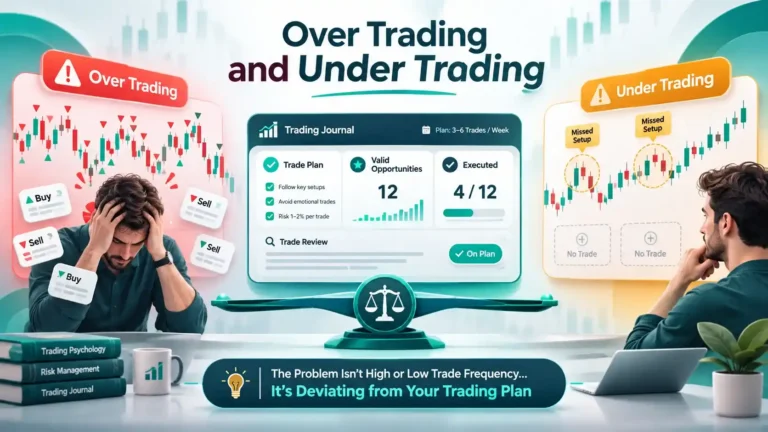
For a broader explanation of the distinction between excessive and insufficient execution, read Jornilo's guide to overtrading and undertrading.
Before-Entry FOMO Checklist
- Can I name the exact setup supporting this entry?
- Does the opportunity still satisfy the current rules?
- Have I calculated risk from the actual entry price?
- Does the intended position size respect the risk budget?
- Am I entering because of a valid setup rather than simply because price is moving?
- Have I checked whether a new setup exists if the original one has expired?
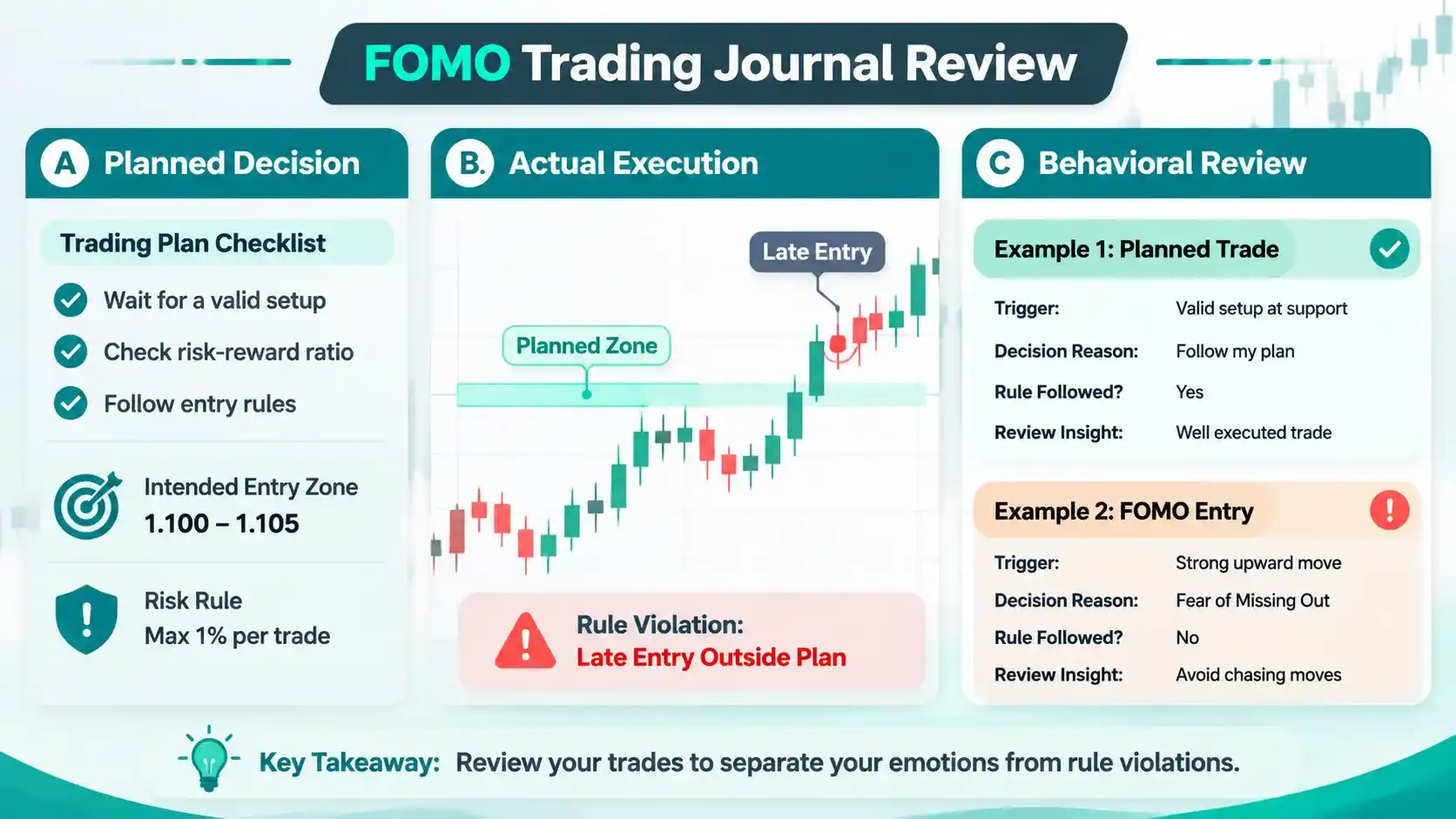
How to Recognize FOMO Patterns in a Trading Journal
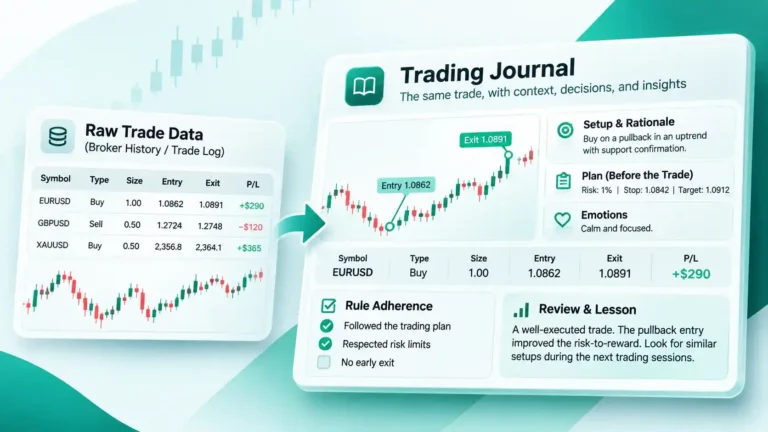
A trading journal can help connect a transaction with the reasoning behind it.
For FOMO analysis, the most important distinction is between the originally planned decision and the actual decision.
This is different from a general trade-frequency audit. The focus here is how urgency may change a particular entry, position size, or rule.
What Should a FOMO Review Record?
| Review Field | What to Record | Why It Matters |
|---|---|---|
| Original setup | The planned entry and required conditions | Establishes the initial trading decision |
| Actual entry | The executed price and time | Shows whether the entry moved away from the plan |
| Current eligibility | Whether the setup was still valid | Separates planned execution from chasing |
| Risk assumptions | Stop, target, position size, and exposure | Reveals changes in potential loss and reward |
| Emotional trigger | The trader's own note about urgency or fear | Records context without assuming a diagnosis |
| Decision reason | Why the trader entered or stayed out | Allows comparison with the original rules |
| Rule compliance | Which rules were followed or violated | Measures process rather than emotion alone |
| Outcome | The subsequent result, if a trade occurred | Keeps financial results separate from decision quality |
A Small Hypothetical FOMO Review Log
| Case | Self-Reported Feeling | Decision | Rule Compliance | Review Focus |
|---|---|---|---|---|
| A | Urgency after missing a move | Entered beyond the expired zone | Off-plan | Price chasing |
| B | Excitement during a breakout | Executed a predefined breakout setup | Compliant | Emotion did not change the rules |
| C | Fear of missing a social-media trade | Skipped because no valid setup existed | Compliant | Appropriate restraint |
| D | Urgency after a rapid price move | Increased position size above the risk limit | Off-plan | Exposure violation |
This log illustrates an important point: experiencing FOMO and violating the trading plan are not the same thing.
A trader may feel excitement and still follow the rules. Another may feel urgency, recognize that the setup is invalid, and correctly stay out.
The financial outcome is a separate piece of information.
How to Use the Review Over Multiple Sessions
After documenting several sessions, look for recurring, specific patterns.
For example:
- Do late entries occur more often after the original setup was missed?
- Are position-size violations associated with particularly fast-moving sessions?
- Do social-media triggers appear repeatedly in notes about off-plan decisions?
- Are some emotionally uncomfortable trades still executed correctly?
- Does the trader frequently enter without recalculating risk at the actual price?
These observations can guide further investigation. They do not establish that an emotion caused a trade or that a particular pattern will continue.
Small samples, incomplete notes, and inconsistent labeling limit what can be concluded.
Can an Online Trading Journal Detect FOMO Automatically?
Transaction records cannot independently reveal a trader's internal emotional state.
An unusual entry, increased position size, or rapid succession of trades might deserve review, but those actions do not prove FOMO.
If your journaling platform does not support recording missed opportunities or emotional context, keep a separate record for that information.
Jornilo provides an online trading journal service. The practical value of journaling is to make trading activity and decision context easier to review; no automatic emotion-detection capability is assumed here.
For a general introduction, see What Is a Trading Journal?. For the broader journaling workflow, read How to Journal Trades.
After-Session FOMO Review Checklist
- Which entries were executed outside the planned entry conditions?
- Did any actual entry have materially different risk from the original setup?
- Were position sizes changed without an approved rule?
- Which emotional triggers did I actually record?
- Which trades were compliant despite emotional discomfort?
- What one specific execution behavior deserves closer attention next session?
What Research Can Tell Us About FOMO and Investing
Research on fear of missing out provides useful background, but it is important not to treat every finding as direct evidence about Forex day trading.
FOMO as a Broader Psychological Concept
Przybylski and colleagues examined the motivational, emotional, and behavioral correlates of fear of missing out in a 2013 study published in Computers in Human Behavior.
That research helps explain FOMO as a broader social and psychological experience. It was not a controlled test of the profitability of Forex trading decisions.
Research: Motivational, Emotional, and Behavioral Correlates of Fear of Missing Out.
FOMO in Cryptocurrency and Stock Investing
A 2023 study by Gerrans, Abisekaraj, and Liu examined relationships between fear of missing out, financial literacy, risk tolerance, and cryptocurrency or stock investment behavior and intentions.
The study reported a stronger association between FOMO and cryptocurrency ownership and ownership intentions than with stock ownership in its research context.
These findings concern the populations and forms of investing studied. They do not establish a universal effect of FOMO on Forex, CFD, or Futures day-trading performance.
Research: The Fear of Missing Out on Cryptocurrency and Stock Investments.
What the Evidence Means for Traders
The available research supports treating FOMO as a potentially relevant influence on financial behavior.
It does not justify assuming that every impulsive trade results from FOMO, that every FOMO experience causes losses, or that one psychological technique will improve trading outcomes for everyone.
For practical review, the most defensible approach is to document actual decisions, identify deviations from predefined rules, and avoid inferring causes from financial outcomes alone.
Common Mistakes When Trying to Avoid FOMO Trading
1. Treating Every Fast Market as Dangerous
Avoiding all fast-moving markets may conflict with a strategy that intentionally trades momentum.
The relevant issue is whether the current entry satisfies the documented plan.
2. Reusing an Outdated Reward-to-Risk Calculation
A reward-to-risk ratio calculated at an earlier entry is not automatically valid at a new price.
Recalculate the potential distances and monetary risk if the entry changes.
3. Changing the Stop Just to Make the Numbers Look Better
A revised stop should follow the strategy's actual invalidation conditions.
Moving it solely to display a more attractive ratio can disguise a weak decision.
4. Assuming Every Missed Move Was a Lost Profit
A trade that was never executed has no realized result.
Historical price movement does not tell you with certainty what would have happened under your actual order execution, position size, and exit rules.
5. Calling Every Losing Trade a FOMO Trade
A losing position may have followed the plan perfectly.
Similarly, a profitable entry may have violated every relevant rule.
Review decision quality separately from realized profit and loss.
6. Treating a Journal Label as Proof of an Emotion
Emotional notes can be useful self-reports, but they are not objective clinical measurements.
Do not assume that transaction timing, P&L, or a single review label proves why someone acted.
7. Confusing FOMO Prevention with Trading Less
A trader does not solve FOMO merely by lowering transaction count.
The goal is to preserve appropriate entries and avoid trades driven by unjustified changes to the plan.
Frequently Asked Questions
What is FOMO trading?
FOMO trading means making or considering trading decisions because of a fear of missing out on a market opportunity. It often appears when traders chase rapidly moving prices, react impulsively to market excitement, or enter positions without following their predefined strategy.
What does FOMO mean in Forex trading?
In Forex trading, FOMO stands for "fear of missing out." It describes the anxiety or urgency a trader may experience when a currency pair moves without them. FOMO can contribute to late entries, unnecessary trades, or changes to planned risk limits.
How can you recognize a FOMO trade?
Possible warning signs include chasing price after missing an entry, trading without a valid setup, increasing position size impulsively, and entering primarily because others appear to be making money. The most useful test is whether the actual trade followed predefined entry and risk rules.
Is entering a trade after a strong price movement always FOMO?
No. A strong price movement can create a valid opportunity for a predefined breakout or momentum strategy. The important distinction is whether the current entry satisfies an established trading plan or results from an impulsive decision driven by urgency.
How does FOMO affect a trade's risk-to-reward ratio?
Entering later at a less favorable price can increase the distance to a fixed stop-loss while reducing the distance to a fixed profit target. This may worsen the potential reward-to-risk ratio. The actual effect depends on the entry, stop-loss, target, position size, and trading strategy.
How can I stop FOMO trading?
Start by defining entry conditions, risk limits, and invalidation rules before trading. When the market moves quickly, check whether a valid setup still exists instead of chasing the previous opportunity. Reviewing impulsive decisions in a trading journal can help identify recurring patterns.
What should I do after missing a trading opportunity?
First determine whether the original setup is still valid. If it has expired, avoid forcing a late entry simply to participate. Wait for another eligible opportunity or a new setup that independently satisfies your strategy and risk requirements.
Can a FOMO trade be profitable?
Yes. A trade influenced by FOMO can produce a profit, just as a fully planned trade can produce a loss. However, a profitable outcome does not prove the decision was appropriate. Trading decisions should also be evaluated against entry criteria, risk rules, and execution quality.
Can a trading journal help identify FOMO trading?
Yes. A trading journal can support FOMO analysis by helping traders compare planned setups with actual entries, document decision reasons, review risk changes, and identify recurring rule violations. A transaction history alone cannot reliably determine a trader's emotional state.
Can FOMO lead to overtrading?
Yes. Fear of missing out can contribute to overtrading when traders enter unnecessary positions, chase moves that no longer meet their strategy, or exceed predefined risk limits. However, not every frequent trader is overtrading, and not every FOMO experience results in a trade.
Final Thoughts: Do Not Let Urgency Replace Your Trading Plan
FOMO trading is not defined by a particular market, a specific candle pattern, or the number of trades placed.
It becomes a concern when fear of missing out changes decisions that should be guided by a predefined strategy and appropriate risk limits.
A late entry may increase the distance to an existing stop, reduce the remaining potential reward, or make the planned position size unsuitable.
But a later entry is not always invalid. A new momentum or continuation setup can be legitimate when it independently meets the trading plan.
The most useful response to FOMO is therefore not a universal instruction to trade less. It is a disciplined process for checking the current setup, recalculating risk, documenting the decision, and learning from repeatable observations.
The FOMO Entry Drift Audit provides a practical way to start that review. It does not predict outcomes or guarantee improved results, but it can clarify what changed between the planned and actual decision.
Research and Regulatory References
These independent research and regulatory sources provide background on fear of missing out, financial behavior, investor decision-making, and Forex risks. They do not validate the FOMO Entry Drift Audit as a scientific diagnostic instrument.
- Przybylski, A. K., Murayama, K., DeHaan, C. R., and Gladwell, V. (2013). Motivational, Emotional, and Behavioral Correlates of Fear of Missing Out. Computers in Human Behavior, 29(4), 1841–1848. University research repository.
- Gerrans, P., Abisekaraj, S. B., and Liu, Z. (2023). The Fear of Missing Out on Cryptocurrency and Stock Investments: Direct and Indirect Effects of Financial Literacy and Risk Tolerance. Journal of Financial Literacy and Wellbeing. Academic article.
- Financial Industry Regulatory Authority. Following the Crowd: Investing and Social Media. Official investor guidance.
- U.S. Securities and Exchange Commission, Office of Investor Education and Assistance. Say "NO GO to FOMO." Investor education article.
- Commodity Futures Trading Commission. Customer Advisory: Eight Things You Should Know Before Trading Forex. Official Forex risk advisory.
Methodology note: All EUR/USD price examples, risk calculations, decision logs, and sample trading situations in this article are hypothetical. The FOMO Entry Drift Audit is an educational comparison framework, not a validated psychological scale or proof of trading profitability. Published research is discussed within the scope of its original population and market context.
Educational Disclaimer: This article is intended for general educational purposes only. It does not provide personalized financial, investment, or trading advice. Forex, CFDs, Futures, stocks, and other financial instruments involve risk, and leveraged trading can result in substantial losses. Hypothetical trades and potential reward-to-risk ratios do not predict actual results. Trading discipline, a journal, and a structured decision process do not guarantee profitability.