November 12, 2026
What Is a Trading Journal? Definition, Purpose & Real Examples
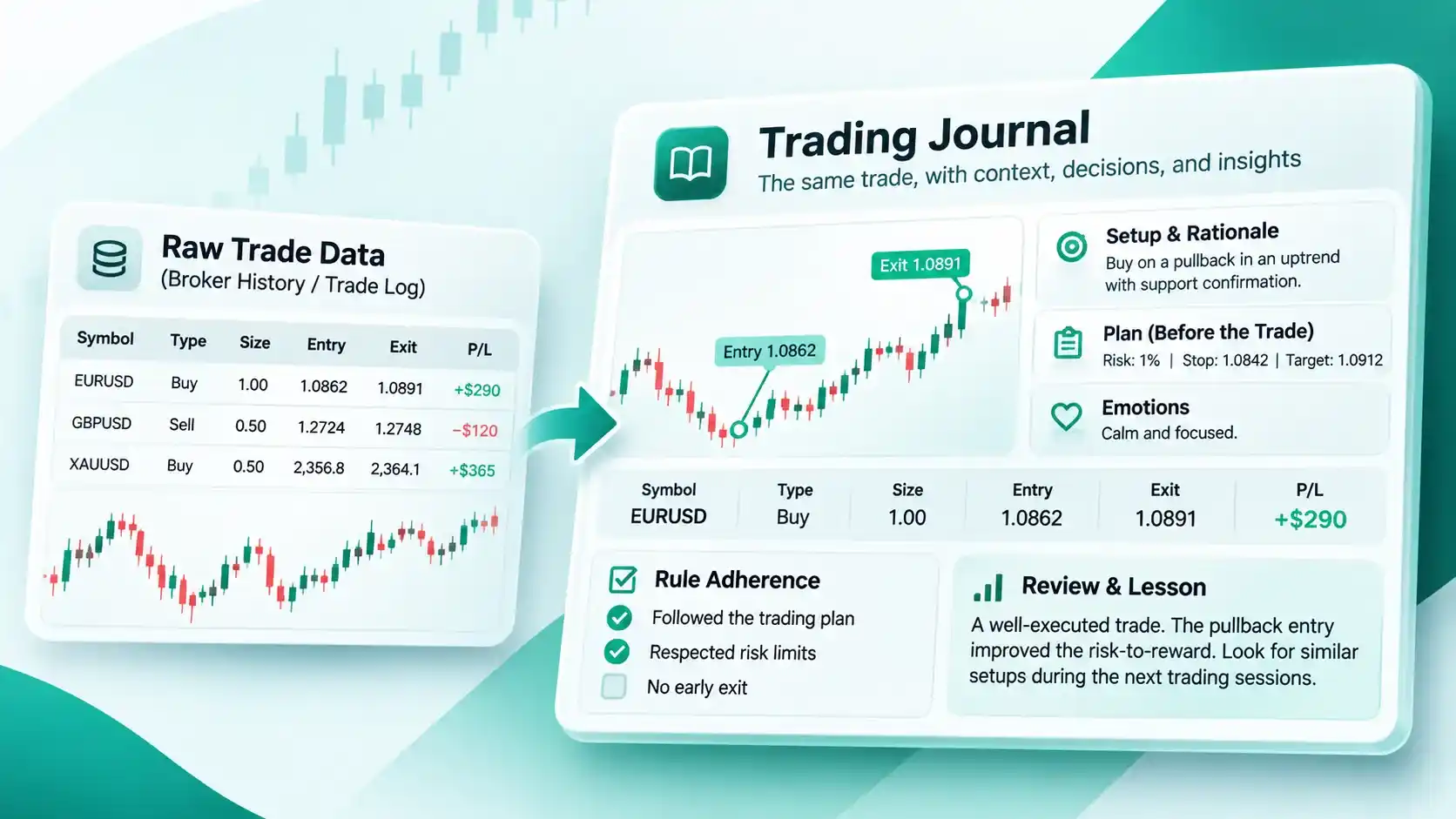
A trading journal is a structured record of your trades, the decisions behind them, and the lessons you learn from reviewing them. Unlike a basic trade history, it captures not only what happened in the market but also why you acted, how you managed risk, and whether you followed your trading plan.
You can keep a trading journal in a notebook, spreadsheet, or dedicated application. The format matters less than the quality and consistency of the information you record.
The essential difference: A trade history tells you what happened. A useful trading journal helps you investigate why you made a decision, whether you followed your rules, and what deserves further review.
Trading Journals at a Glance
- What it is: A record of trades, decisions, risk, and reflections.
- What it tracks: Trade details, strategy, execution, results, and rule adherence.
- Why it matters: It creates a reviewable history instead of relying on memory.
- Who uses it: Beginners and experienced traders across Forex, CFDs, Futures, and other markets.
- What it cannot do: Guarantee profitability or prove that a strategy works from a handful of trades.
What Is a Trading Journal?
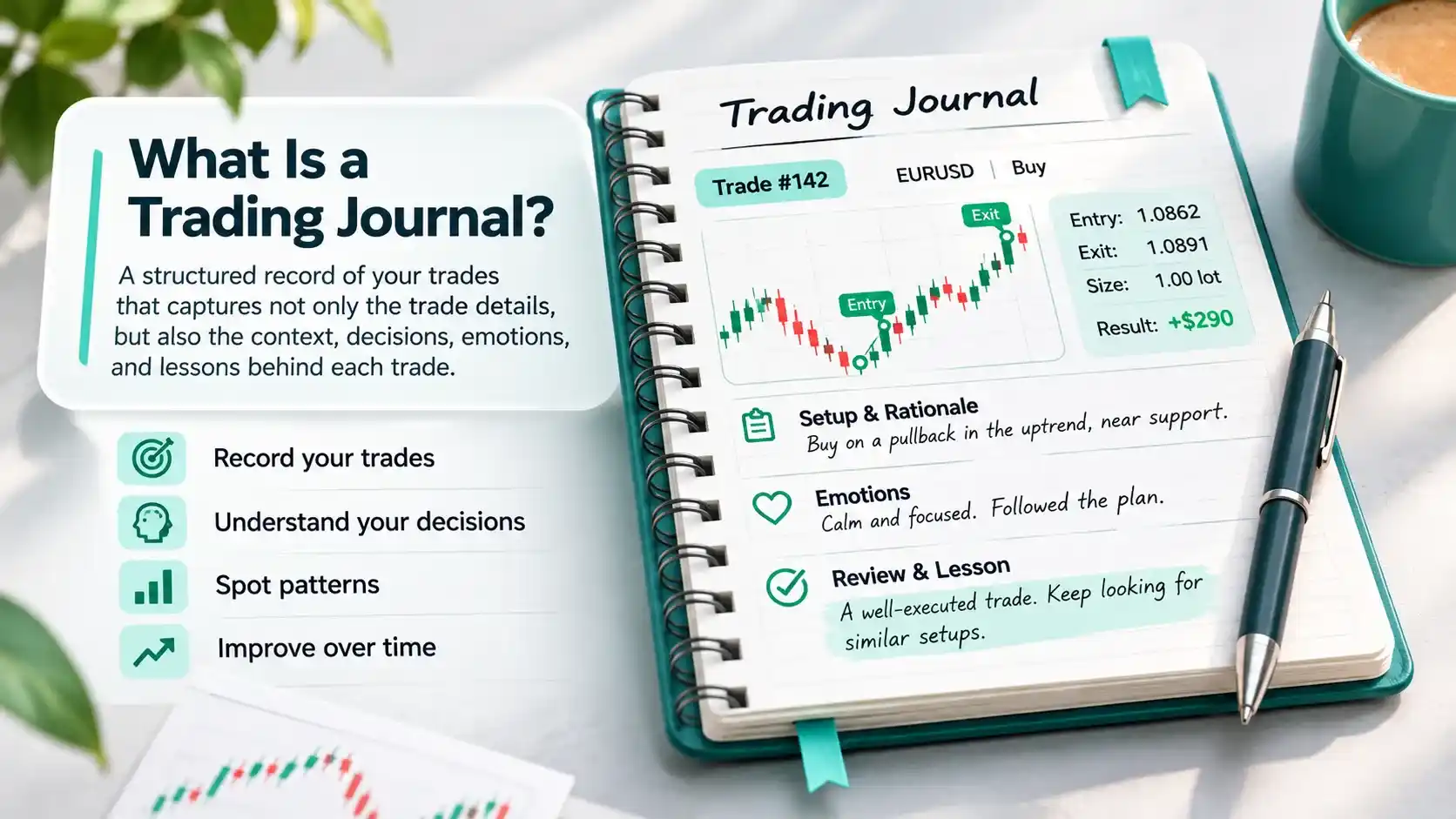
A trading journal is a personal recordkeeping and review system that combines objective trading data with information about your decision-making process.
It typically answers three questions:
- What happened? Which instrument did you trade, when did you enter and exit, how much did you risk, and what was the result?
- Why did it happen? Which strategy, market conditions, and decision rules influenced your actions?
- What can you learn? Did you follow your plan, which behaviors deserve attention, and what should you investigate further?
These three layers make a journal more useful than a list of completed transactions.
Consider two hypothetical traders who each make $100 on a trade. One follows a documented setup and risk limit. The other enters impulsively, takes excessive risk, and happens to exit at a profit.
Their profits are identical, but the processes that produced them are not. A broker statement may display the same financial result for both. Their journals would reveal very different decisions.
What Does a Trading Journal Look Like?
A simple journal might look like a spreadsheet with rows for individual trades and columns for entry price, exit price, risk, result, and notes.
A more detailed version may include chart screenshots, strategy labels, emotional observations, rule-adherence checks, and performance summaries.
The defining feature is not how the journal looks. It is whether the information allows you to review both the trade outcome and the quality of the decisions behind it.
Trading Journal vs. Trade Log vs. Broker Statement
These three tools are related, but they do not necessarily provide the same information.
A broker statement records transactions and account activity. A trade log organizes trade information for tracking and comparison. A trading journal adds the reasoning, context, and reflections needed to investigate your decisions.
| Feature | Broker Statement | Trade Log | Trading Journal |
|---|---|---|---|
| Primary purpose | Document account activity and transactions | Organize trading results | Review decisions and performance |
| Entry and exit prices | Usually included | Usually included | Included |
| Position size and result | Usually included | Usually included | Included |
| Trading setup | Not typically recorded | Optional | Recommended |
| Reason for entry | Not typically recorded | Optional | Recorded as decision context |
| Emotions and behavior | Not typically recorded | Optional | Can be documented and reviewed |
| Rule adherence | Not typically recorded | Optional | Can be evaluated |
| Lessons and next actions | Not typically recorded | Optional | Part of the review process |
The boundaries are not absolute. Some broker platforms offer detailed analytics, and some trade logs include notes and strategy tags. A sufficiently detailed trade log can function as a trading journal.
The practical distinction is whether the information explains the decisions behind your trading results.
Example: A broker statement can tell you that a position closed at a loss of $200. A journal can additionally show whether you respected a predefined $200 risk limit or increased the loss by moving your original stop.
What Does a Trading Journal Include?
An effective trading journal combines two types of information: trade facts and decision context.
Beginners should start with the minimum information needed to reconstruct and review a trade. Additional fields should serve a clear analytical purpose rather than making the journal unnecessarily complicated.
Essential Trading Journal Fields
- Date and Instrument When you traded and which market, currency pair, or contract you used.
- Direction and Size Whether the position was long or short and its actual size.
- Entry and Exit The actual execution prices and, where useful, their timestamps.
- Planned Risk The original stop level and amount you intended to risk.
- Trade Result Gross and net profit or loss, including relevant trading costs.
- Setup and Rationale The strategy and conditions that justified the trade.
- Plan Adherence Whether your entry, management, and exit respected your predefined rules.
- Review Note A specific observation or question to investigate later.
Optional Fields for Deeper Analysis
Depending on your trading approach, you may also benefit from recording:
- Chart screenshots before and after the trade.
- Market session and relevant economic events.
- Emotional state before entry and during management.
- Strategy tags and specific rule violations.
- R-multiple and realized risk-to-reward.
- Spread, commission, financing, and slippage where applicable.
- Market conditions such as trend, volatility, or liquidity.
For example, a Forex trader might record the London or New York session to examine whether execution differs by trading hours. A Futures trader might record the exact contract and tick value. A CFD trader may need to account for the broker's contract specifications and financing charges.
These differences matter because the same field can represent different financial exposures across markets.
The Minimum Viable Trading Journal
If you are just starting, you do not need dozens of performance statistics. The following compact structure is sufficient to begin collecting meaningful information:
This is a starting structure, not a universal rule. You can expand it once you identify a question that your current records cannot answer.
A Complete Trading Journal Example
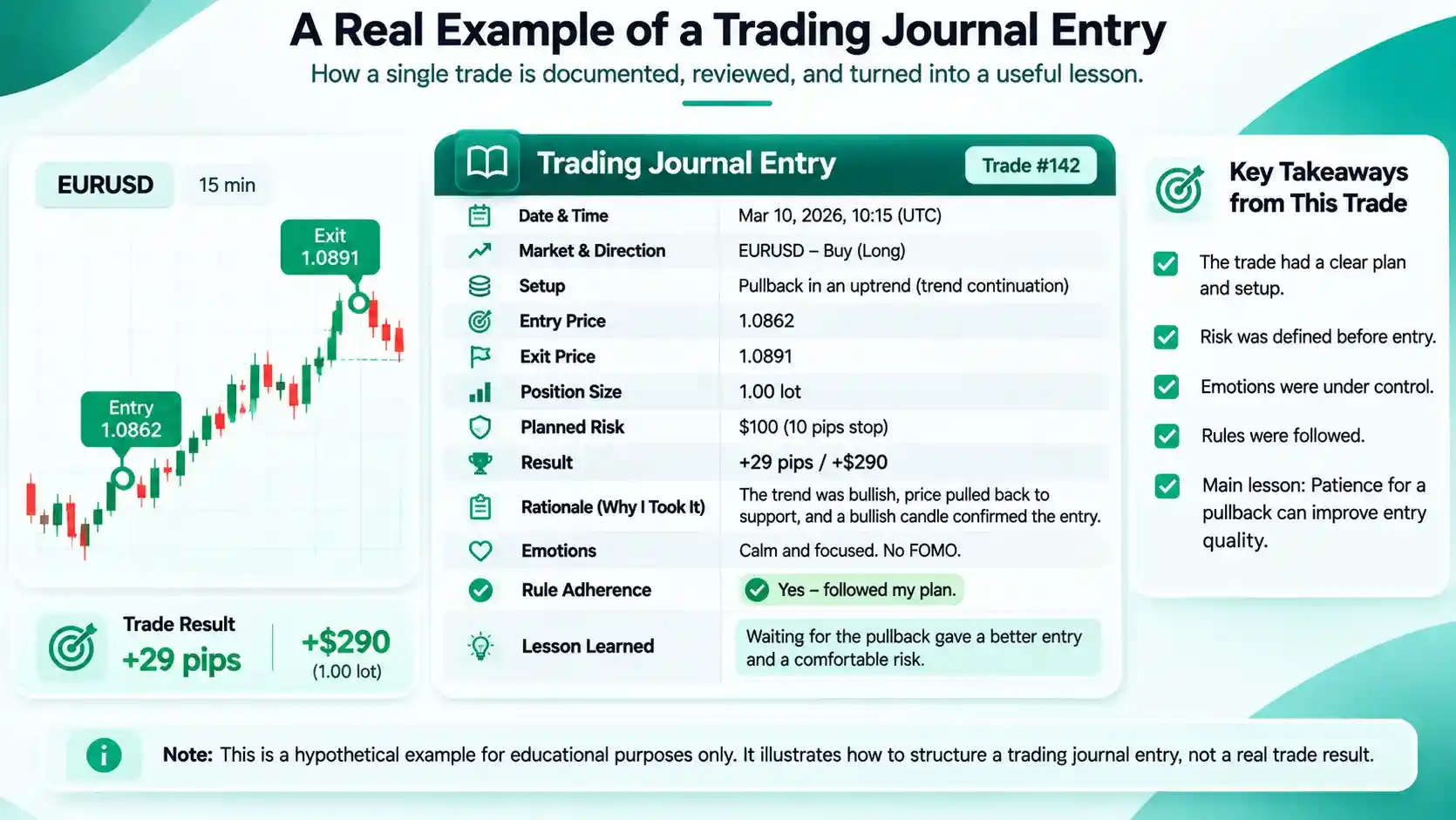
To understand how trading data and decision notes fit together, consider the following fictional EUR/USD trade.
Hypothetical scenario: A trader identifies a pullback in an uptrend and plans a long position after a predefined confirmation signal.
The trade is recorded with its original risk plan, actual execution, financial outcome, and post-trade observations.
| Journal Field | Hypothetical Entry |
|---|---|
| Instrument | EUR/USD |
| Direction | Long (Buy) |
| Setup | Trend-following pullback with confirmation |
| Entry Price | 1.0862 |
| Initial Stop Loss | 1.0842 |
| Planned Target | 1.0912 |
| Actual Exit Price | 1.0891 |
| Position Size | 1 standard lot (100,000 EUR) |
| Initial Risk | 20 pips / $200 before costs |
| Planned Reward | 50 pips / $500 before costs |
| Planned Reward-to-Risk | 2.5:1 |
| Realized Price Movement | +29 pips |
| Gross Trading Result | +$290 |
| Illustrative Additional Fees | $12 |
| Illustrative Net Result | +$278 |
| Realized Net R-Multiple | +1.39R |
| Reason for Entry | Price pulled back toward a predefined support area within an uptrend, followed by the required confirmation. |
| Emotional Observation | Felt impatient while waiting for confirmation but did not enter early. |
| Rule Adherence | Entry and risk rules followed; the exit occurred before the original target under an assumed predefined management rule. |
| Review Note | Continue documenting whether the same entry conditions are followed across comparable setups. |
Checking the Numbers
For EUR/USD, where USD is the quote currency, a standard 100,000-unit lot has a pip value of $10. For this example:
- Initial stop distance: 1.0862 minus 1.0842 = 0.0020, or 20 pips.
- Planned risk: 20 pips × $10 = $200 before costs.
- Planned reward: 1.0912 minus 1.0862 = 50 pips, or $500 before costs.
- Actual price movement: 1.0891 minus 1.0862 = 29 pips.
- Gross result: 29 × $10 = $290.
- Illustrative net result: $290 minus $12 in assumed additional fees = $278.
- Net R-multiple: $278 ÷ $200 = +1.39R.
The calculations assume a single unadjusted long position, no partial exits, and a USD-denominated account. Entry and exit prices are treated as actual fills. The $12 cost is a fictional example of additional fees, not a quoted broker charge. Actual costs, contract specifications, and execution conditions vary.
For more detail on how lot size affects pip value, see the educational explanation of Forex lot sizes from CMC Markets.
What Does This Example Actually Prove?
It shows how to document the financial and behavioral sides of a trade in one record.
It does not prove that the setup has a profitable edge. A single winning trade cannot establish the expected performance of a strategy.
It also demonstrates why planned and realized results should be kept separate. This trade had a planned reward-to-risk ratio of 2.5:1, but the actual exit occurred earlier, producing a lower realized R-multiple.
Without a journal, that difference might be overlooked. With the original plan recorded, the trader can review whether early exits are consistent with the strategy or deserve closer investigation.
Why Trade Outcome and Decision Quality Are Different
One of the most useful concepts in trade journaling is separating the result of a position from the quality of the decision that produced it.
A profitable trade can involve poor risk management. A losing trade can follow every predefined rule.
This distinction matters because financial markets involve uncertainty. You cannot evaluate every trading decision solely by whether the outcome was positive or negative.
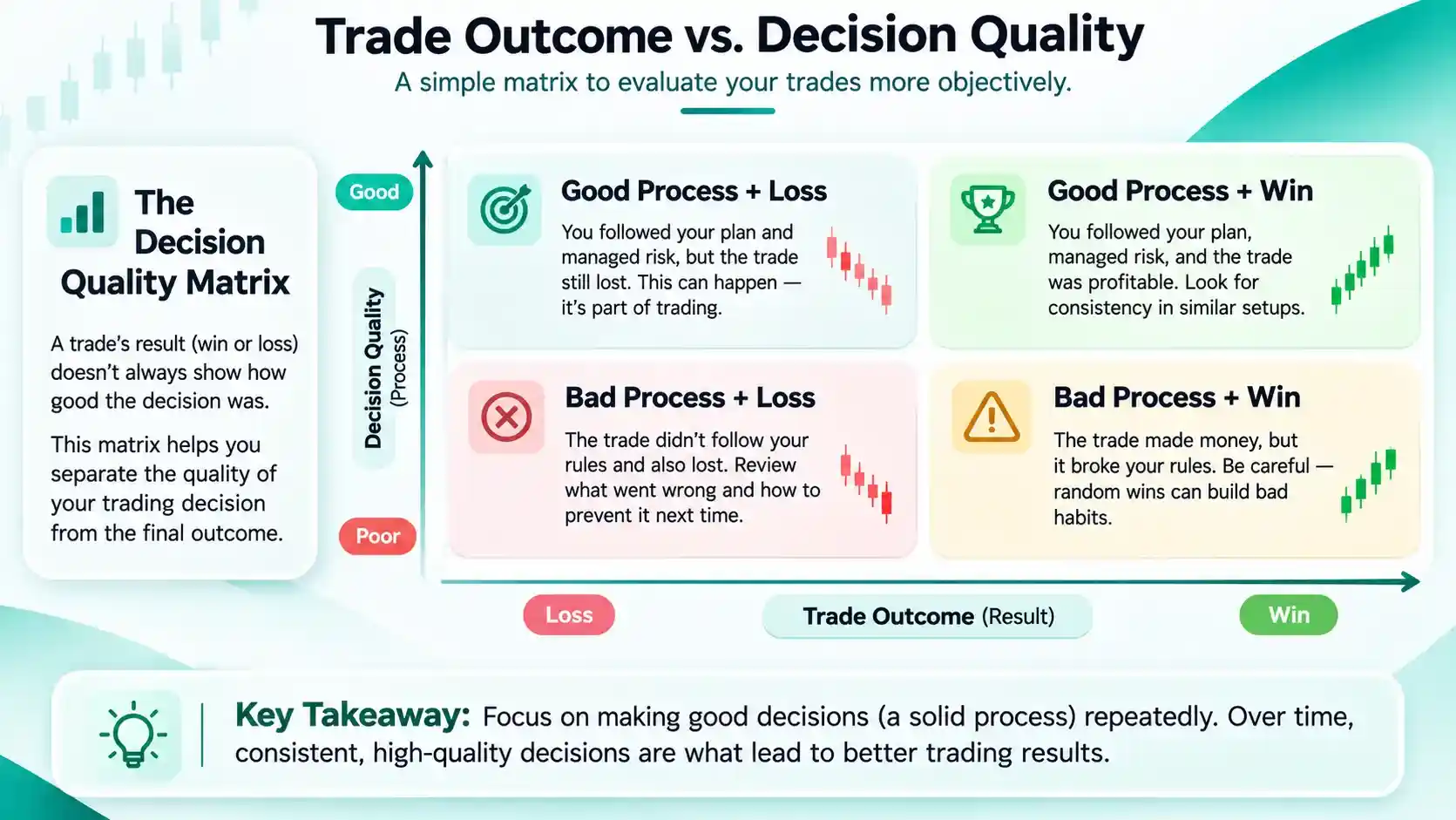
The Trading Decision Quality Matrix
The following educational framework organizes trades into four categories.
Good Process + Win
The trader follows the documented strategy, manages risk according to plan, and finishes with a profit.
Review question: Was the execution repeatable, or were unusual market conditions responsible for the result?
Good Process + Loss
The trader follows the plan, but the market moves against the position and the trade loses.
Review question: Was this a normal losing outcome within the strategy's rules?
Bad Process + Win
The trader breaks a rule, takes an impulsive position, or exceeds a risk limit, but still makes money.
Review question: Which rule was broken, and could the same behavior create unacceptable risk later?
Bad Process + Loss
The trader deviates from the plan and also experiences a financial loss.
Review question: Which part of the execution can be corrected, independently of the market outcome?
Important distinction: In this matrix, "good process" means adherence to a predefined, risk-aware plan. It does not mean the strategy itself has been proven profitable. A trader can execute a flawed strategy consistently, so strategy quality and execution quality must be evaluated separately.
Two Trades, Same Profit, Different Lessons
Imagine two hypothetical trades that each close with a $150 profit.
Planned Execution
The trader waits for a predefined setup, enters with a documented stop, follows the position-management rules, and closes with a profit.
Journal insight: Execution matched the plan. The trader can compare this trade with other trades using the same setup.
Impulsive Execution
The trader enters without confirmation, increases the position beyond the risk limit, and exits at a profit after an unfavorable move.
Journal insight: The positive result does not excuse the risk violation. The behavior deserves review despite the profit.
A result-only trading log might classify both trades as successful. A decision-focused trading journal shows why that conclusion would be incomplete.
What Makes a Trading Journal Entry Actually Useful?
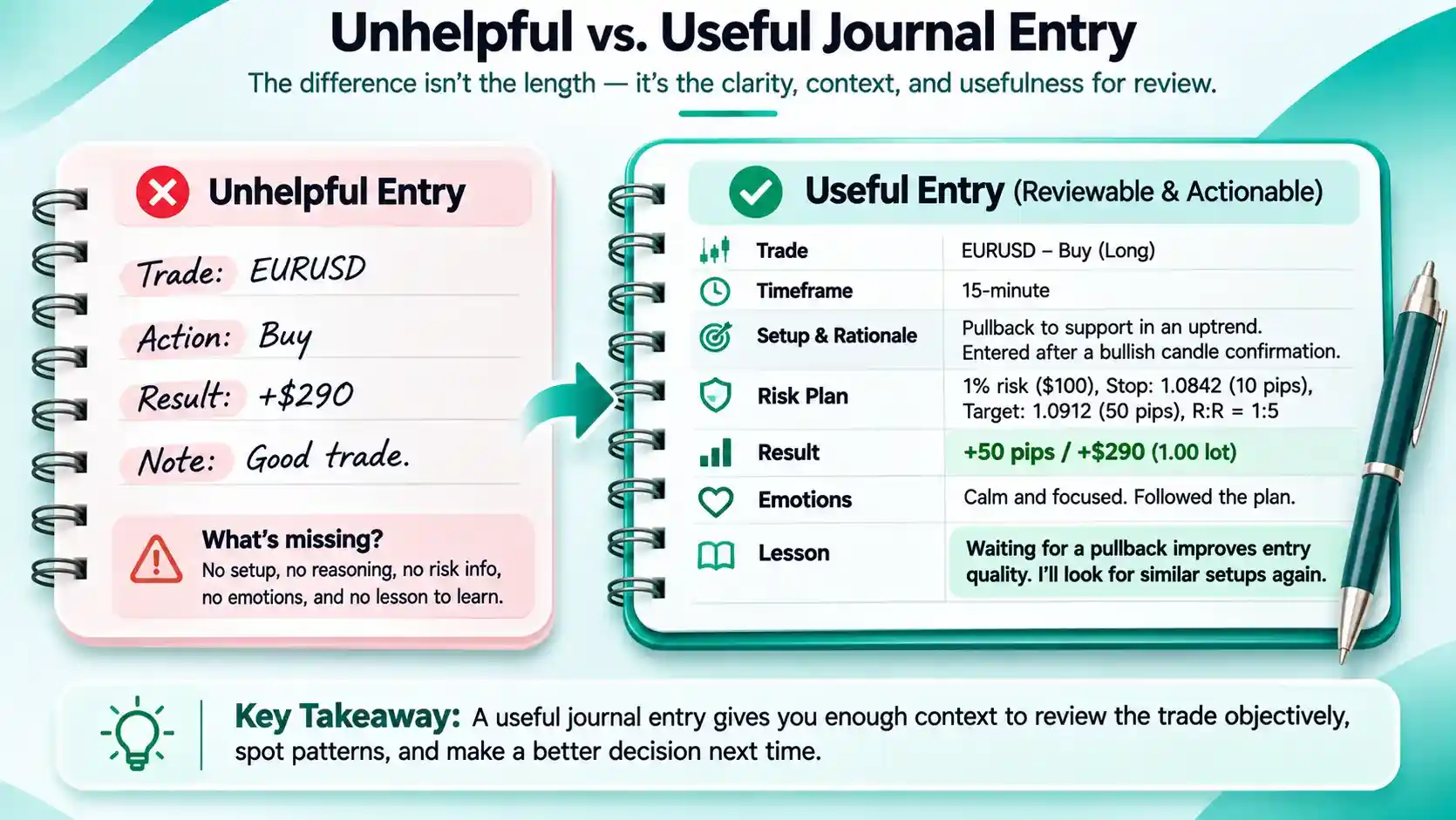
A useful journal entry is not necessarily a long one. It is specific enough that you can understand and evaluate it later without having to reconstruct the trade from memory.
Unhelpful Entry
Result: Profit
Note: Good trade. Felt confident.
This entry tells you very little about the decision. It does not identify the setup, the original risk, whether rules were followed, or what could be learned.
Useful Entry
Setup: Pullback toward predefined support within an uptrend.
Entry reason: Entered only after the planned confirmation condition occurred.
Risk plan: Stop and position size were set before entry.
Execution: Followed the entry and risk rules.
Observation: Felt impatient during the wait but did not enter early.
Review question: How consistently do I wait for confirmation across similar setups?
This second entry gives the trader something to examine. It describes a specific behavior and a question that can be investigated using additional trades.
The Reviewability Test
Before adding more information to your journal, ask whether someone reviewing the record later could answer these questions:
- What did I plan before knowing the result?
- What did I actually do?
- Where did execution differ from the plan?
- What evidence supports my interpretation?
- What specific question should I investigate next?
If the journal entry answers those questions, it is already more valuable than a vague description of a winning or losing trade.
Why Do Traders Use Trading Journals?
Traders use journals to make their trading activity easier to review, measure, and understand.
The benefits are practical, but they depend on the accuracy of the records and whether the trader actually reviews them.
1. To Identify Repeated Trading Behaviors
A journal may reveal repeated early entries, stop-loss adjustments, impulsive position increases, or exits that differ from the plan.
The benefit comes from documenting comparable behaviors consistently rather than relying on isolated memories.
2. To Separate Strategy Problems From Execution Problems
Suppose a trader has a documented entry strategy but regularly enters before confirmation.
Poor results could reflect weaknesses in the strategy, inconsistent execution, or both. Recording the intended setup and actual behavior helps the trader investigate these possibilities separately.
3. To Review Risk Management
A trading journal can document planned risk, actual position size, stop-loss placement, and deviations from risk limits.
This is particularly important in leveraged markets, where relatively small price movements can produce substantial financial consequences.
The U.S. Commodity Futures Trading Commission explains the risks associated with leveraged retail Forex trading in its Forex customer advisory.
4. To Understand Emotional Context
Traders may experience impatience, hesitation, frustration, or overconfidence during a trading session.
Recording these observations can help identify possible relationships between emotional states and execution decisions.
However, emotional labels are subjective. A journal can show that certain observations appear alongside certain behaviors; it does not automatically prove that an emotion caused a particular trade outcome.
5. To Support More Structured Performance Reviews
A journal can make it easier to review trades by strategy, instrument, market session, risk level, or rule adherence.
Depending on the information available, traders may examine metrics such as win rate, average win, average loss, profit factor, drawdown, and R-multiples.
These metrics describe historical results. They are not guarantees of future performance.
What a Trading Journal Can and Cannot Tell You
A well-maintained journal provides evidence about what you recorded. It does not eliminate uncertainty from trading.
| A Journal Can Help You Examine | A Journal Cannot Establish by Itself |
|---|---|
| Whether you followed recorded trading rules | Whether those rules produce a profitable strategy |
| Historical outcomes of recorded setups | How those setups will perform in the future |
| Recurring execution mistakes | The exact cause of every loss |
| Patterns in recorded emotions and behavior | A proven causal relationship between emotion and results |
| Results and risk across a documented sample | Reliable conclusions from an insufficient or biased sample |
Five Limitations Worth Understanding
Small Sample Sizes
A few trades rarely provide enough evidence to evaluate the reliability of a strategy. Results can be heavily influenced by chance, changing market conditions, and unusual events.
There is no universal number of journal entries that guarantees a statistically reliable conclusion. The amount of evidence needed depends on the question, the strategy, and the variability of outcomes.
Incomplete Records
A journal containing only memorable winners or frustrating losses creates selection bias.
Missing trades, inconsistent fees, incorrect position sizes, and incomplete exit records can distort performance metrics and the conclusions drawn from them.
Hindsight Bias
After seeing how a trade ended, it may be tempting to describe the original decision as more predictable than it actually was.
Separating observations recorded before entry from notes added after the result helps preserve the original decision context.
Correlation Is Not Causation
Suppose a journal shows that trades labeled "impatient" often produce poor results.
That pattern is worth investigating. It does not prove impatience caused the losses. Trading conditions, setup quality, position sizing, or other factors might also explain the relationship.
Process Quality Is Not Strategy Validation
Following a trading plan consistently is measurable, but it does not automatically make the plan effective.
A complete review should distinguish whether the trader followed the rules from whether those rules deserve continued use.
A useful rule: Treat journal findings as evidence to investigate, not immediate proof that you have discovered a profitable strategy or the cause of every trading mistake.
Paper Notebook, Spreadsheet, or Trading Journal Software?
A trading journal does not need to be expensive or technically complicated.
Each format has advantages and limitations. The right choice depends on the number of trades you take, the information you need, and how you prefer to review your records.
| Format | Advantages | Limitations | Consider It When |
|---|---|---|---|
| Paper Notebook | Simple, flexible, and useful for writing detailed reflections | Harder to search, calculate statistics, and compare large numbers of trades | You trade infrequently or prefer handwritten notes |
| Spreadsheet | Customizable fields, formulas, filtering, and charts | May require manual entry and maintenance of formulas | You want control over the structure and are comfortable with spreadsheets |
| Dedicated Software | Purpose-built organization and potentially more convenient analytics | Features, data import, pricing, and limitations vary by provider | You need more structured reviews or want to reduce manual work |
A notebook can be sufficient for a small number of trades. A spreadsheet may provide everything needed for structured recordkeeping and basic analysis.
Dedicated software becomes worth considering when the time spent organizing and reviewing trading information starts interfering with consistent journaling.
Before choosing software, verify that it supports the markets and data formats you actually use. Check how trades are imported, how costs are handled, what analytics are available, and whether you can export your records.
Which Type of Trading Journal Do You Need?
Rather than beginning with a long feature checklist, start with the problem you want the journal to solve.
You Mainly Need Accurate Records
If your primary goal is organizing entries, exits, position sizes, and net results, a structured trade log may be sufficient.
Start with: A simple spreadsheet or basic digital record.
You Want to Understand Your Decisions
If you need to review strategy adherence, risk decisions, emotions, and execution mistakes, add contextual notes and regular review.
Start with: A complete trading journal with clear decision fields.
You Need to Compare Larger Sets of Trades
If you frequently compare setups, instruments, trading sessions, or risk patterns, structured analytics may save time.
Consider: A well-designed spreadsheet or dedicated journaling software.
You Have Records but Rarely Review Them
If your data is already organized but you do not use it, changing tools may not solve the underlying problem.
Prioritize: A manageable review routine and specific questions to investigate.
A Practical Three-Question Decision Test
To choose a suitable system, answer these questions:
- Can I reconstruct what happened in each trade? If not, improve your transaction records first.
- Can I explain why I made each important decision? If not, add strategy, risk, and execution notes.
- Can I compare enough similar trades to investigate a specific question? If not, improve your organization and review process before adding more metrics.
This framework helps match your journaling method to your actual needs without assuming that the most complex software is always the best choice.
What Should You Do After Understanding Trading Journals?
Once you understand what a trading journal is, the next step is to create a recording process that you can maintain consistently.
Begin by defining the essential information you need to capture. Decide which details come directly from your trading platform and which observations you must add yourself.
Then establish a practical way to review your records. A journal that is never examined may preserve history, but it will not automatically produce useful insight.
For the complete implementation process, including what to record before and after trades, practical examples, and daily and weekly review checklists, read our guide: How to Journal Trades: A Step-by-Step Guide.
One practical starting point: For your next group of trades, consistently record the original plan, actual execution, net result, and whether you followed your rules. Review those fields together before deciding which additional data would help answer your next question.
Frequently Asked Questions
What is the main purpose of a trading journal?
The main purpose is to create a reliable record of trading activity and decision-making. A journal helps traders examine their execution, risk management, recurring behaviors, and historical performance instead of relying only on memory or recent results.
What is the difference between a trade log and a trading journal?
A trade log primarily records transactions and results. A trading journal also captures the reasons behind decisions, the trading plan, execution quality, and review notes. The two can overlap when a trade log includes sufficient contextual information.
What should a beginner include in a trading journal?
A beginner can start with the instrument, date, direction, position size, entry and exit prices, initial stop, net result, strategy, rule adherence, and one specific review note. Optional details can be added when they serve a clear analytical purpose.
Can a trading journal improve profitability?
A trading journal does not guarantee profitability. It can help traders document behavior, investigate mistakes, and evaluate historical outcomes. Whether those findings translate into better financial results depends on the strategy, market conditions, execution, costs, and risk management.
Is a spreadsheet enough for a trading journal?
Yes. A spreadsheet can be sufficient for recording trades, adding decision notes, and calculating performance metrics. Dedicated software may offer convenience, but the best choice depends on your needs and the features actually available.
Does a trading journal need to record emotions?
Emotional notes are not required for every type of journal, but they may help traders examine possible relationships between their mental state and execution decisions. These observations should be specific and interpreted cautiously rather than treated as proof of causation.
Final Thoughts: A Trading Journal Is More Than a Record of Trades
A trading journal brings together three important elements: what happened, why you acted, and what the available evidence may teach you.
Its value does not come from collecting the largest number of statistics or writing the longest trade notes. It comes from preserving accurate information, documenting decisions honestly, and reviewing comparable trades with a clear purpose.
If you are new to trading journals, start with the essential fields. If you already maintain records, focus on whether those records help you distinguish strategy quality from execution quality.
Most importantly, remember that a profitable trade is not automatically a good decision, and a losing trade is not automatically a mistake. A useful journal helps you evaluate those questions with more context.
Further Reading and Sources
The following resources provide additional information on trading journals, position sizing, and financial risk. The journal examples and educational frameworks in this article are illustrative and do not represent actual Jornilo user data.
- CMC Markets — Trading Journals: The Missing Link in the Trading Process — Context, execution, and decision review.
- CMC Markets — Forex Lot Sizes — Standard lot sizes and pip-value calculations.
- U.S. CFTC — Eight Things You Should Know Before Trading Forex — Regulatory education about Forex risks and leverage.
- Investor.gov — Investor Alert: Excessive Trading at Investors' Expense — Risks associated with excessive trading and transaction costs.
Educational Disclaimer: This article is provided for general educational purposes only and does not constitute personalized investment or financial advice. All trading examples, prices, fees, and results are hypothetical. Forex, CFD, and Futures trading involve substantial risk, particularly when leverage is used. A trading journal does not guarantee profitability, reduce market uncertainty, or validate a trading strategy on its own. Past performance is not a reliable indicator of future results.