November 8, 2026
How to Journal Trades: Step-by-Step Guide (2026)
A successful trade does not always mean you made a good decision. Likewise, a losing trade does not necessarily mean your strategy was wrong. To understand the difference, you need a reliable way to record what happened, why you entered a position, how you managed it, and what you can learn from the outcome.
That is where a trading journal becomes valuable. Learning how to journal trades helps you move beyond remembering individual wins and losses toward reviewing your decisions with evidence.
Whether you trade Forex, CFDs, or Futures, this guide will walk you through creating a trading journal, documenting each trade, measuring your performance, identifying recurring mistakes, and establishing a review routine you can realistically maintain.
What Is a Trading Journal?
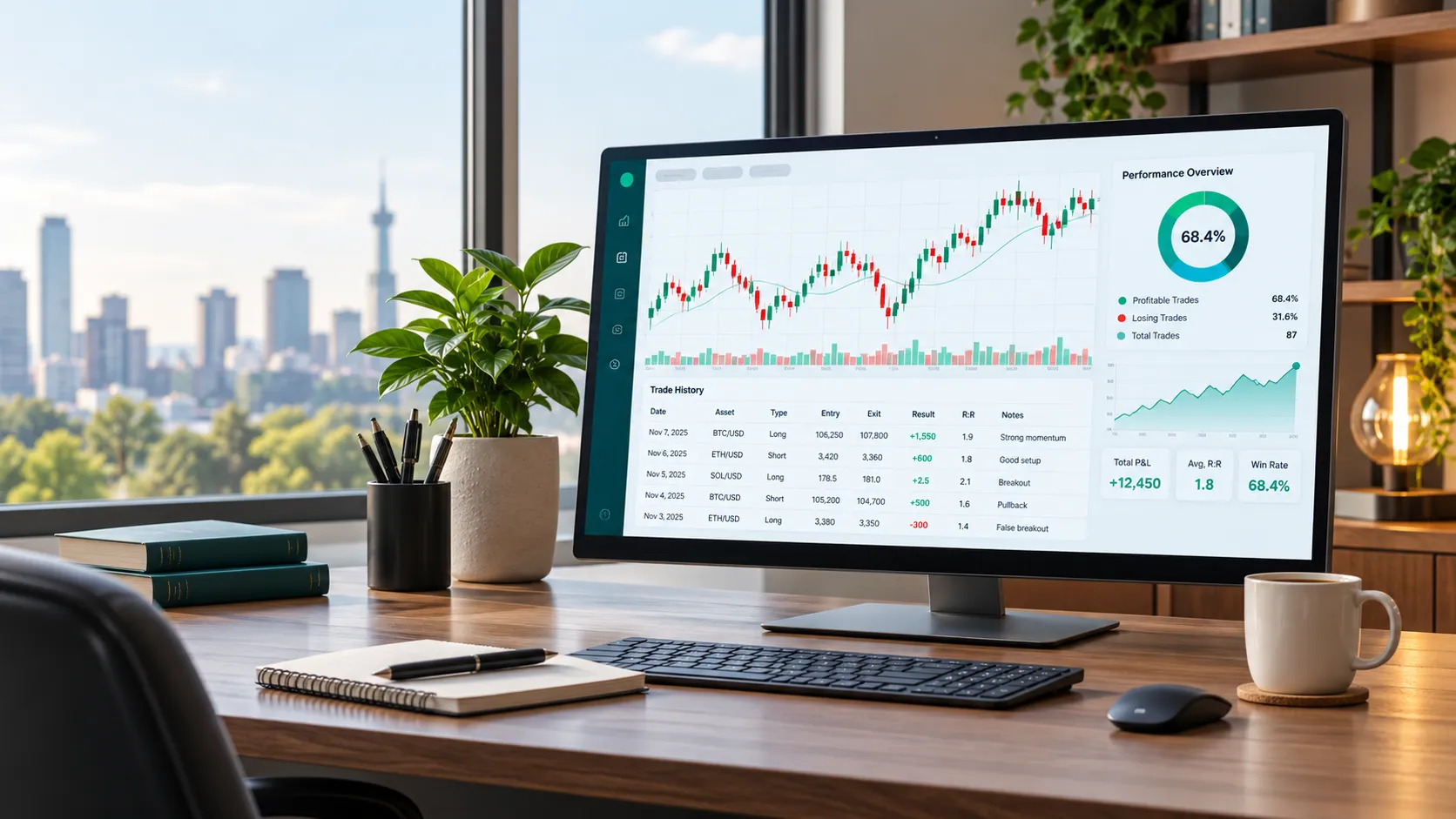
A trading journal is an organized record of your trades and the decisions behind them. It typically includes entry and exit prices, position size, risk, trading strategy, market conditions, trade results, and personal observations.
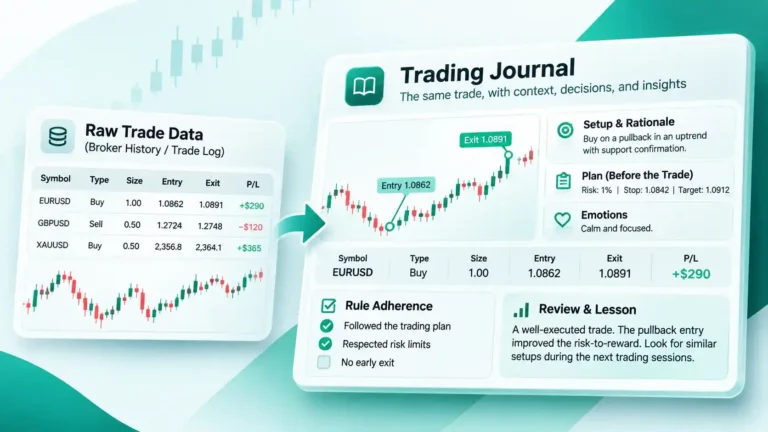
Unlike a basic transaction history, a useful trading journal explains the context of each decision. It can show not only whether a position made or lost money, but also whether you followed your trading plan.
For example, imagine two traders who both lose money on a EUR/USD trade. The first followed a predefined setup and respected the stop loss. The second entered impulsively and moved the stop loss after the market moved against the position.
Their financial outcomes may look similar, but their decision-making processes are very different. A trading journal helps reveal that distinction.
Trading Journal vs. Trading Log
A trading log generally focuses on transaction details, such as the instrument, entry price, exit price, and profit or loss. A trading journal adds context, including the reasoning, emotions, strategy rules, and lessons associated with each trade.
The terms are often used interchangeably, and a good trading journal can include both types of information. The important distinction is whether your records allow you to evaluate the quality of your trading process.
Why Should You Keep a Trading Journal?
Traders often remember their biggest winners, frustrating losses, or emotionally significant decisions. Unfortunately, selective memory is not a dependable basis for evaluating a trading strategy.
Consistent trade journaling helps replace impressions with documented observations.
- Identify recurring mistakes: Recognize patterns such as entering early, overtrading, moving stop losses, or abandoning planned exits.
- Evaluate trading strategies: Compare outcomes from different setups instead of judging a strategy based on a few memorable trades.
- Review risk management: Track planned risk, actual losses, position sizing, and deviations from risk limits.
- Understand emotional patterns: Notice whether frustration, fear, impatience, or overconfidence affects your decisions.
- Measure consistency: Review how often you follow your trading plan, regardless of the result.
- Support continuous learning: Turn trading observations into specific actions you can test and review.
Key principle: The purpose of a trading journal is not to prove that every trade was right. It is to help you understand what your trading records reveal and what you should investigate next.
What Should You Record in a Trading Journal?
Before learning how to make a trade journal, decide which information matters to your trading approach. A useful journal should collect enough detail to support meaningful analysis without becoming unnecessarily complicated.
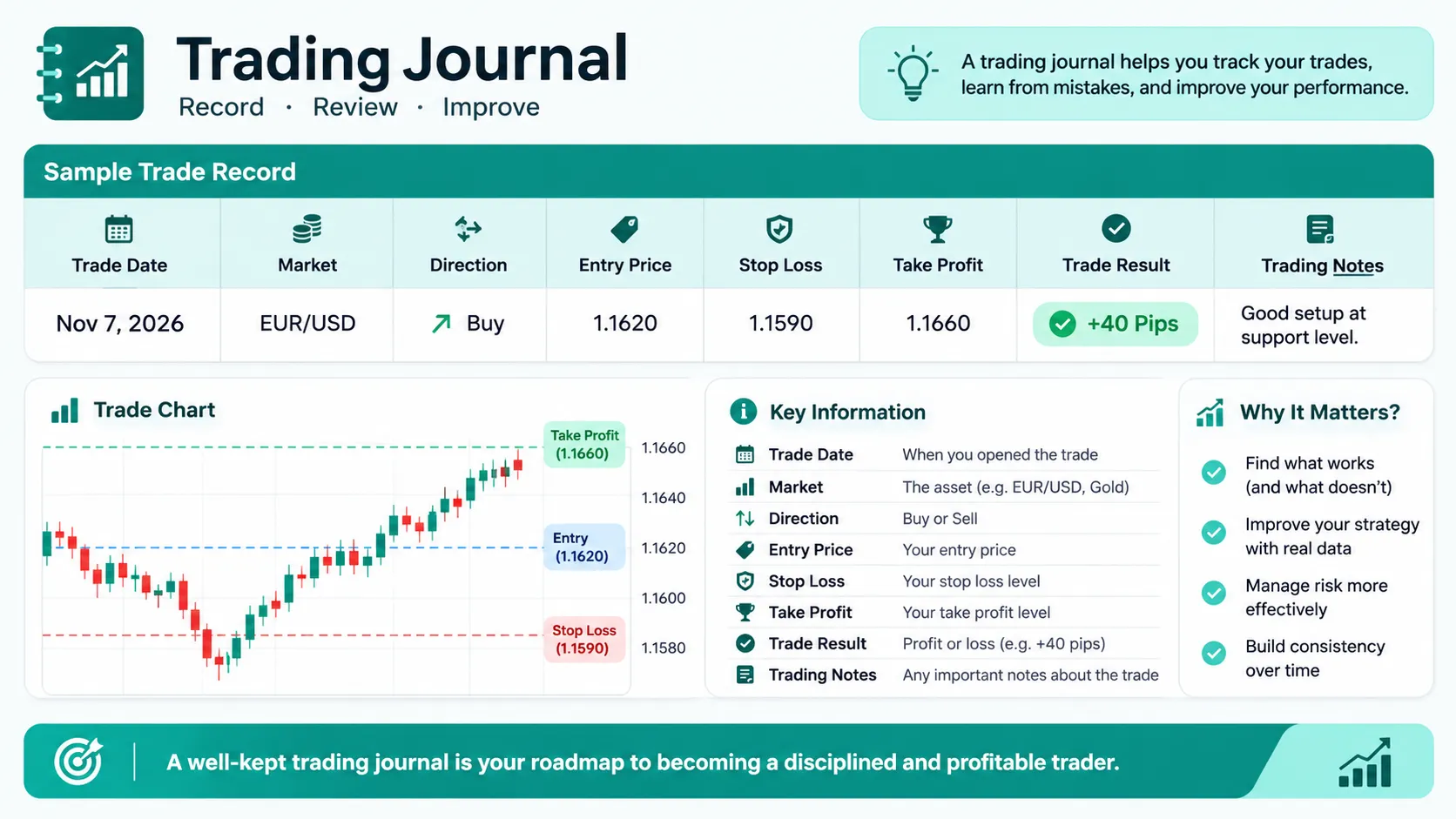
Essential Trade Information
| Field | What to Record | Why It Matters |
|---|---|---|
| Trade Date and Time | When the position was opened and closed | Helps analyze trading sessions and timing |
| Market / Instrument | EUR/USD, gold, an index, or a Futures contract | Allows comparison across markets |
| Trade Direction | Long or short | Identifies the direction of the position |
| Entry and Exit | Actual execution prices | Documents how the trade was executed |
| Stop Loss and Target | Planned invalidation and profit-taking levels | Shows the original risk and reward plan |
| Position Size | Lots, units, or contracts | Supports exposure and risk analysis |
| Trading Setup | Strategy name and entry conditions | Helps compare repeatable setups |
| Trade Result | Net profit or loss, fees, and R-multiple where applicable | Measures the financial outcome |
| Emotions and Notes | Mental state, observations, and decisions | Reveals possible behavioral patterns |
| Rule Adherence | Whether the trade followed the plan | Separates process quality from outcome |
Beginners do not need to fill dozens of fields. Start with the essentials, then expand your journal when you have a clear reason to capture more information.
Additional Information Worth Tracking
As your journaling habit develops, consider recording screenshots of your setup, market volatility, economic news context, trading session, planned risk percentage, and whether your execution differed from your plan.
These details are particularly useful when investigating why similar-looking trades produce different outcomes.
How to Journal Trades: A Step-by-Step Process
The following workflow explains how to create a trading journal and use it consistently. You can follow the same process with a spreadsheet, notebook, or dedicated trading journal software.
Step 1: Choose Your Trading Journal Format
Start by choosing a format that you can update and review regularly.
- Paper notebook: Simple for recording thoughts and decisions, but less convenient for calculations and searching previous trades.
- Spreadsheet: Flexible and useful for organizing data, calculations, and basic performance analysis.
- Digital trading journal: Designed around structured trade records, review workflows, and trading-performance analysis.
The best starting format is the one you can maintain. A sophisticated journal is not useful if recording a trade becomes so time-consuming that you stop using it.
Step 2: Write Your Trading Plan Before Entry
Before opening a position, document the reason for taking the trade.
Record the market, strategy, entry conditions, planned entry, stop loss, target, position size, and the amount you intend to risk.
Ask yourself:
- Does this trade match a defined strategy?
- What specific condition supports the entry?
- At what price would the setup be invalidated?
- How much capital could be lost if the stop is reached?
- Are there market conditions that would make me avoid the trade?
Writing these details before execution gives you a documented plan against which to evaluate your later decisions.
Step 3: Record the Actual Trade Execution
Once a trade is opened, record the actual execution details rather than relying solely on the prices you intended to receive.
Note differences between planned and executed entry prices, changes to position size, and any adjustments to the original stop or target.
If you make an adjustment, document what changed and why. This helps distinguish planned trade management from impulsive decisions made under pressure.
Step 4: Document the Outcome and Your Behavior
After closing a trade, enter the exit price, realized profit or loss, applicable costs, and the reason for exiting.
Then review your behavior. Did you follow your original plan? Did fear cause you to close early? Did frustration influence your position sizing?
Use objective, specific notes whenever possible. For example, "Moved stop loss after entry without a predefined rule" is more useful than "Bad trade."
Step 5: Review Your Trades and Identify Patterns
Individual trades provide observations. Reviewing multiple trades helps you identify patterns that may deserve further investigation.
Group your trades by strategy, instrument, session, or setup. Compare financial results alongside execution quality, risk management, and rule adherence.
Look for recurring behaviors rather than immediately changing your strategy after a losing trade.
Step 6: Turn Your Findings Into Specific Improvements
A trading journal becomes more valuable when you use what you learn.
If your records show repeated entries before confirmation, for example, your next action might be to create a clearer entry checklist and monitor whether you follow it.
Change one process at a time when practical. This makes it easier to evaluate whether your adjustments improve consistency.
Trading Journal Example: Recording a Forex Trade
The following hypothetical example shows how to write a trading journal entry for a Forex trade. All prices and results are fictional and are provided solely to demonstrate the recording process.
Example Trade: EUR/USD Long Position
| Journal Field | Example Entry |
|---|---|
| Market | EUR/USD |
| Direction | Long |
| Strategy | Trend-following pullback |
| Entry Price | 1.0850 |
| Initial Stop Loss | 1.0820 |
| Planned Target | 1.0910 |
| Actual Exit | 1.0910 |
| Planned Risk | 30 pips |
| Planned Reward | 60 pips |
| Planned Reward-to-Risk Ratio | 2:1 |
| Illustrative Gross Result | +2R, before trading costs |
| Trade Notes | Entered after the predefined pullback conditions were met. |
| Emotional Notes | Felt impatient during the pullback but waited for confirmation. |
| Rule Adherence | Followed the documented plan. |
| Lesson | Continue recording whether entry confirmation rules are followed. |
In this example, the initial risk was 30 pips and the trade achieved a favorable move of 60 pips. The illustrative gross result is therefore +2R, where 1R represents the predefined amount risked on the trade. The example assumes the position was not partially closed or adjusted.
The actual financial result would also depend on position size, pip value, execution, spreads, commissions, and other applicable costs. A complete journal should distinguish gross trade performance from net results.
Important: Even though this fictional trade reached its target, it does not prove that the underlying strategy is profitable. Strategy evaluation requires examining a larger collection of comparable trades and accounting for trading costs and risk.
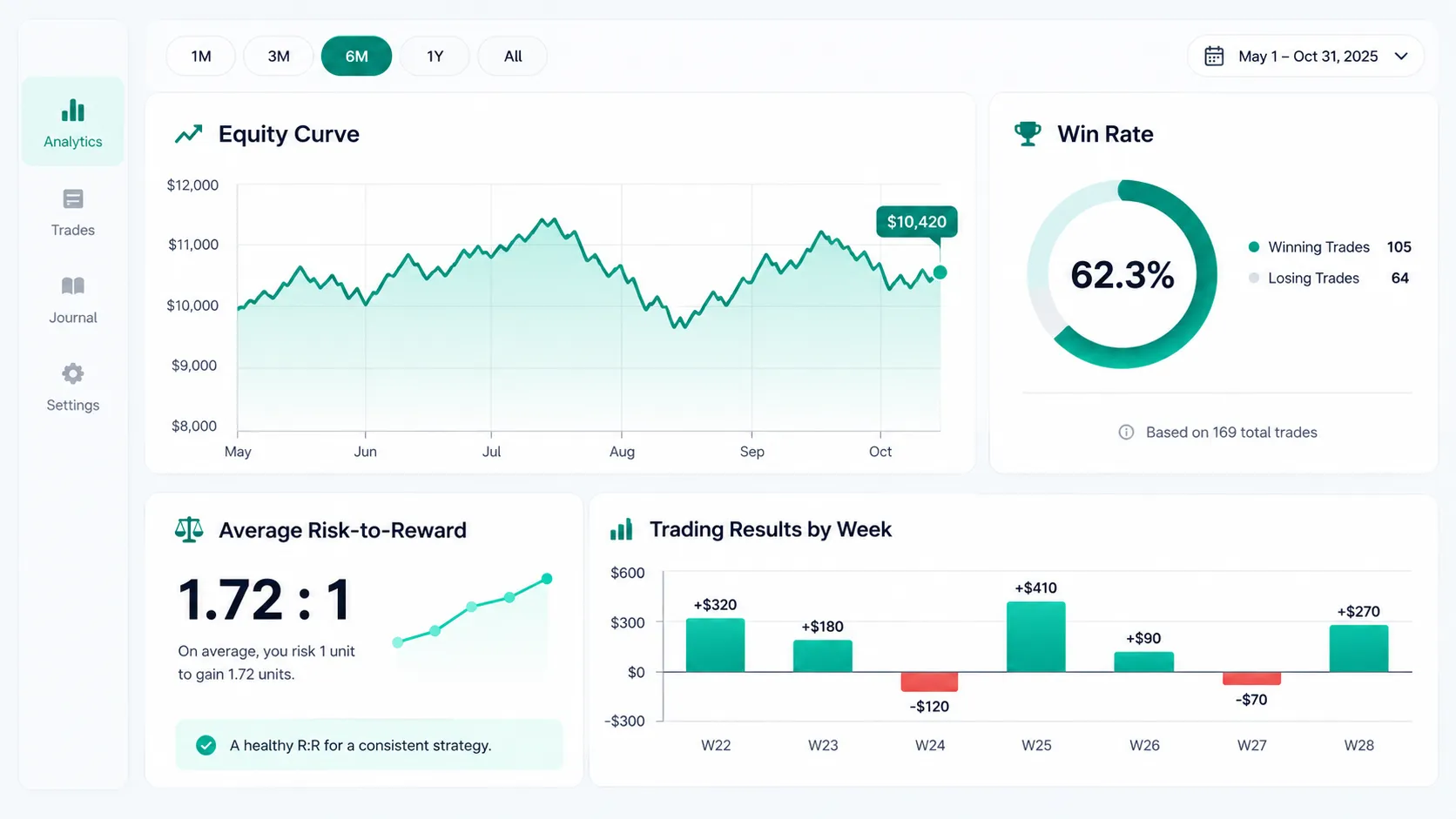
How to Analyze Your Trading Journal
Recording trades is only the beginning. The next step is turning your journal into a useful source of performance information.
You do not need advanced statistical expertise to get started, but understanding several basic metrics can make your reviews more meaningful.
1. Win Rate
Win rate is the percentage of closed trades that were profitable.
Win Rate = (Winning Trades ÷ Total Closed Trades) × 100
For example, if 18 of 40 closed trades were profitable, the win rate would be 45%.
A high win rate does not automatically indicate a profitable strategy. The size of winning and losing trades also matters.
2. Average Win and Average Loss
Compare the average profit from winning trades with the average loss from losing trades. This provides context that win rate alone cannot offer.
A strategy can have more losing trades than winners and still produce a positive result if its average winners are sufficiently larger than its average losers, after costs.
3. R-Multiple
An R-multiple expresses a trade's result relative to its predefined risk.
For example, a result of +2R means the trade earned twice the amount initially risked, while -1R represents a loss equal to that amount.
Tracking R-multiples can help compare trades with different position sizes, provided the initial risk is recorded consistently.
4. Profit Factor
Profit factor compares gross profits from winning trades with the absolute value of gross losses from losing trades.
Profit Factor = Gross Profit ÷ Absolute Gross Loss
A value above 1 indicates that aggregate profits exceeded aggregate losses over the measured period, before any costs not already included. The metric is undefined when gross losses are zero.
Profit factor should be interpreted alongside sample size, drawdown, trading costs, and the consistency of the underlying strategy.
5. Drawdown
Drawdown measures the decline from a previous equity peak to a subsequent low. It provides an important perspective on risk that total profit alone does not capture.
Reviewing drawdown can help you understand the depth of unfavorable performance periods and whether your actual risk exposure aligns with your plan.
6. Strategy and Rule Adherence
Financial performance is only part of the picture. Track the percentage of trades that followed your predefined rules.
This can help you distinguish between a trading approach that needs further evaluation and execution habits that are inconsistent with the original plan.
How to Keep a Trading Journal Consistently
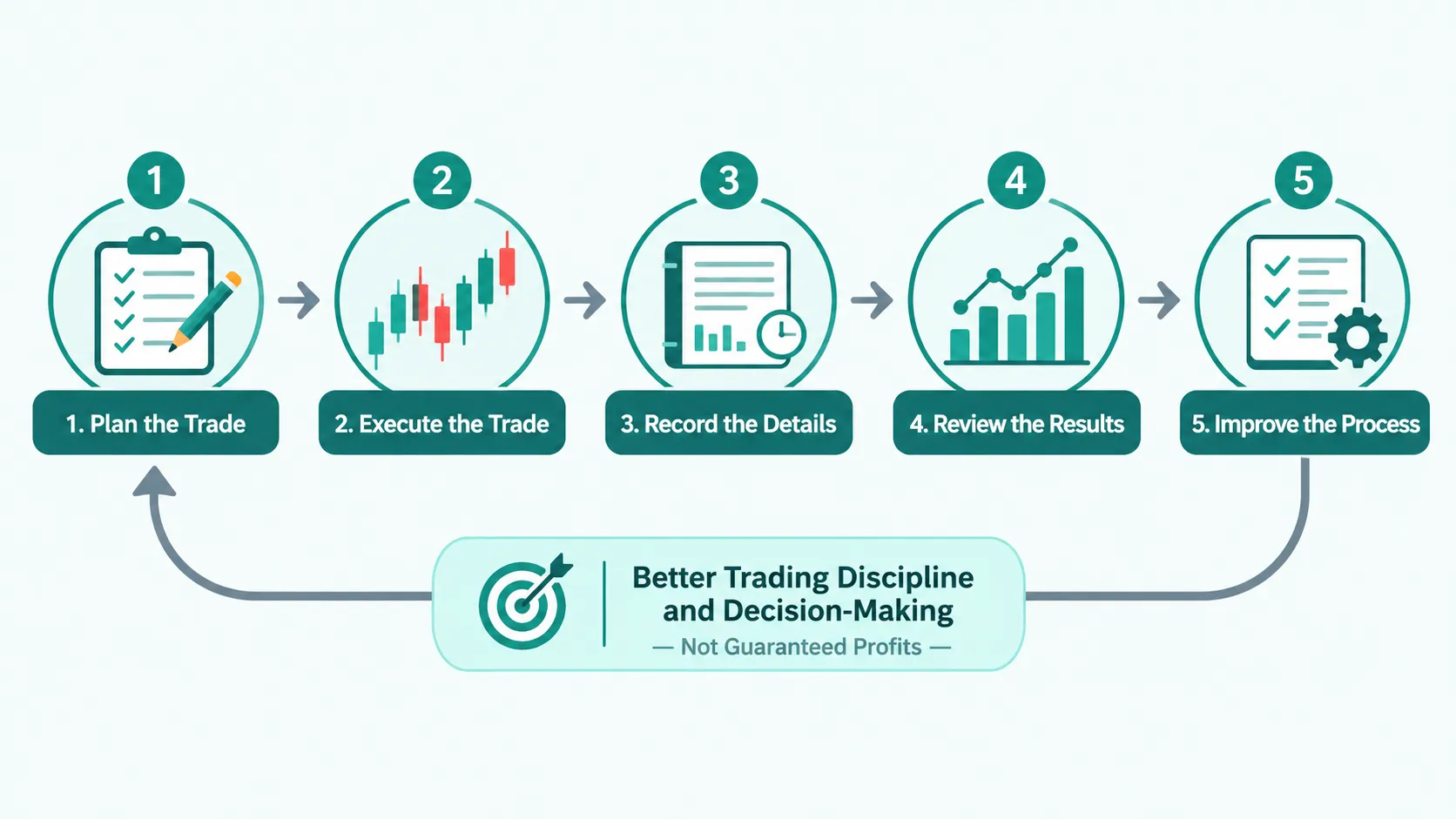
One of the biggest challenges is not creating a journal. It is maintaining the habit.
A practical way to keep a trading journal is to separate your work into short daily updates and a more detailed weekly review.
Daily Trading Journal Checklist
Complete these tasks after each trading session:
- Record all completed trades and verify execution details.
- Document the strategy or setup used for each trade.
- Update net results, including applicable trading costs.
- Record any deviation from planned risk or position size.
- Note relevant emotions and execution decisions.
- Save useful chart screenshots or contextual observations.
- Identify one lesson or question worth reviewing.
Weekly Trading Journal Review
Once a week, examine your completed trades together rather than evaluating each result in isolation.
- Review total trades, net performance, and risk exposure.
- Compare results across different trading setups.
- Check win rate, average win, average loss, and R-multiples.
- Identify repeated violations of your trading rules.
- Review emotional patterns that may have affected execution.
- Select one specific improvement for the following week.
- Document what you will monitor to evaluate that improvement.
Keep your weekly review constructive. The objective is to identify useful patterns and decisions, not to criticize yourself for every losing position.
Common Trading Journal Mistakes to Avoid
If you are learning how to write a trading journal, avoiding a few common mistakes can make your records much more useful.
Recording Only Winning Trades
A journal that excludes losing positions creates an incomplete picture of your performance. Record every trade, including unsuccessful trades and trades that did not follow your plan.
Tracking Profit and Loss Without Context
Profit and loss figures alone do not explain why a trade occurred. Include the strategy, entry conditions, risk plan, and relevant decisions so that your records remain meaningful during later reviews.
Writing Vague Notes
Notes such as "good setup" or "poor execution" are difficult to evaluate. Use specific descriptions of the conditions, actions, and outcomes involved.
Changing the Journal Too Frequently
Constantly modifying fields and performance categories can make comparisons difficult. Establish a manageable structure and adjust it when you discover a clear limitation.
Ignoring Fees and Execution Costs
Spreads, commissions, slippage, financing costs, and other applicable charges can affect actual trading performance. Record these costs wherever they are relevant to the instruments you trade.
Drawing Conclusions From Too Few Trades
A small number of trades may not represent how a strategy performs under different market conditions. Treat early patterns as questions to investigate rather than definitive conclusions.
Never Reviewing the Journal
A journal that is updated but never reviewed becomes a historical record rather than a practical learning tool. Make reviewing trades part of your routine.
Should You Use a Spreadsheet or Trading Journal Software?
Both approaches can support disciplined trade journaling. The appropriate choice depends on your trading activity, the level of analysis you need, and how much manual work you are comfortable performing.
| Consideration | Spreadsheet | Dedicated Trading Journal Software |
|---|---|---|
| Customization | Highly flexible when you design the structure yourself | Depends on the available fields and settings |
| Initial Setup | May require creating tables and formulas | Typically offers a predefined journaling structure |
| Performance Analysis | Can be built with formulas, tables, and charts | May provide purpose-built trading analytics |
| Trade Import | Usually requires manual entry or a configured import process | Import options vary by provider and integration |
| Maintenance | Formulas and reporting may need manual upkeep | Depends on software features and provider support |
| Cost | Depends on the spreadsheet platform and tools used | Depends on the provider and subscription model |
A spreadsheet can be a practical starting point, especially for traders with simple recordkeeping needs. If your trading activity grows and you want a more structured way to review your trading data, dedicated software may be worth exploring.
Jornilo is an online trading journal focused on helping traders organize trade records and understand trading performance. You can explore its trading journal offering to determine whether it fits your preferred workflow.
How Trading Psychology Fits Into Your Journal
Trading psychology is not just about labeling emotions as good or bad. It involves recognizing how your thoughts, expectations, and emotional reactions influence your decisions.
A useful trading journal can help you observe these influences more systematically.
Record Your State Before and After a Trade
Consider noting whether you felt calm, impatient, distracted, frustrated, or overly confident before entering a position.
After the trade, describe whether your emotional state influenced your execution. Focus on observable actions instead of making broad judgments about your personality.
Look for Repeated Behavioral Patterns
Over time, review whether certain behaviors appear repeatedly in similar situations.
For example, you might notice that after two consecutive losses, you are more likely to enter a trade without completing your setup checklist.
This observation does not automatically prove that the losses caused the behavior. However, it gives you a specific pattern to investigate.
Separate Emotional Awareness From Strategy Evaluation
A trade can follow every rule and still lose. A trade can break several rules and still win.
Your journal should capture both outcomes and decision quality so that you do not accidentally reward poor execution simply because the market moved in your favor.
How to Build a Trading Journal Habit That Lasts
A sustainable journaling routine is built around consistency and simplicity.
Start with a small number of essential fields. Record each trade while the details are fresh, and schedule time for periodic review.
If you find yourself skipping entries, simplify your process. If you are collecting large amounts of information that you never analyze, remove unnecessary fields or develop a specific review question for them.
Most importantly, treat your journal as a decision-support tool rather than a scorecard for judging your worth as a trader.
Practical starting point: For your next set of trades, consistently record the instrument, strategy, entry, exit, initial risk, net result, and rule adherence. At the end of the review period, identify which additional information would help explain your results.
Frequently Asked Questions About Trading Journals
How do you journal trades as a beginner?
Start with a simple table recording the date, instrument, trade direction, entry price, exit price, stop loss, position size, result, and reason for the trade. Add brief notes about your decisions and review your entries regularly.
What is the best way to keep a trading journal?
The best approach is one you can maintain consistently. Use a notebook, spreadsheet, or digital journal that captures your essential trade details and allows you to review both financial results and trading decisions.
Can I create a trading journal in Excel or Google Sheets?
Yes. A spreadsheet can organize trade records, calculate basic performance metrics, and display charts. You may need to create and maintain the formulas and reporting structure yourself.
What should a Forex trading journal include?
A Forex trading journal should include the currency pair, trade direction, entry and exit prices, stop loss, target, position size, execution costs, strategy, result, and relevant notes about market conditions and decisions.
How often should I review my trading journal?
Record trades as soon as practical after execution, and consider a short review after each session. A weekly review can help identify patterns across multiple trades, while longer review periods can provide additional context for performance evaluation.
Does keeping a trading journal make you profitable?
No trading journal guarantees profitability. Journaling can help traders document decisions, review performance, and identify areas for improvement, but trading outcomes remain subject to market uncertainty, strategy quality, risk management, and execution.
What is the difference between a trading journal and a trade tracker?
A trade tracker primarily organizes transaction and performance data. A trading journal can include those records while also documenting strategy decisions, behavior, emotions, and lessons. The functionality may overlap depending on the tool.
Final Thoughts: Start Journaling Your Trades Today
Learning how to journal trades is not about creating the most complicated spreadsheet or collecting as many statistics as possible. It is about developing a consistent system for understanding what you do in the market.
Begin by recording your plans, actual executions, results, and observations. Review those records regularly, identify recurring patterns, and use your findings to guide specific changes in your trading process.
Whether you choose a notebook, spreadsheet, or dedicated trading journal, consistency matters more than complexity. A well-maintained journal gives you a clearer record of your decisions and a more informed starting point for evaluating your trading performance.
Educational disclaimer: This article is provided for educational and informational purposes only. It does not constitute personalized financial or investment advice. Forex, CFD, and Futures trading involve financial risk, including the possibility of substantial losses. Hypothetical examples do not represent actual trading performance or guaranteed results.