November 13, 2026
Over Trading and Under Trading: Signs, Causes & Fixes (under over trading)
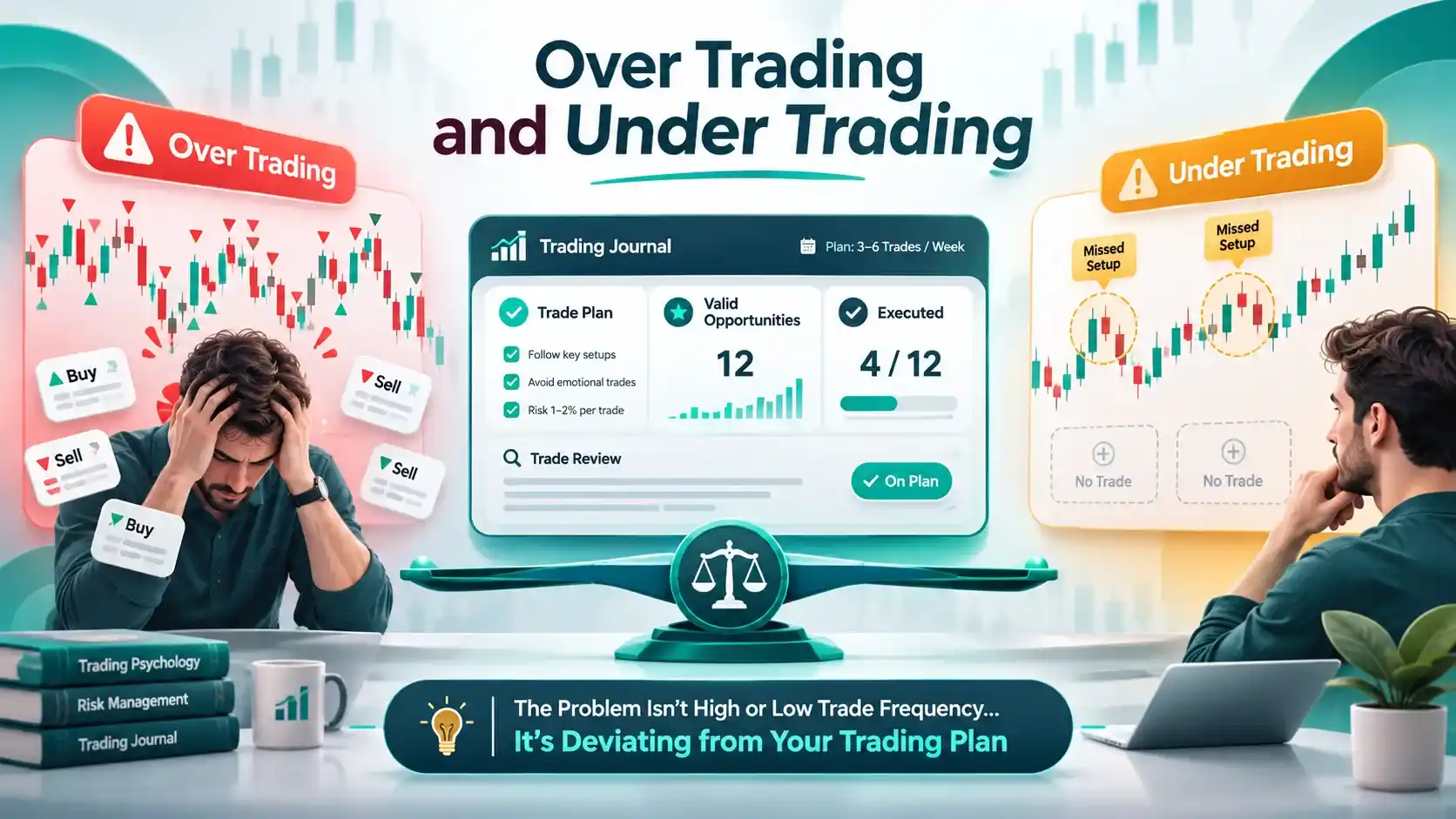
Over trading and under trading are opposite problems in trading execution. Overtrading means taking unnecessary, oversized, or off-plan trades. Undertrading means repeatedly missing otherwise eligible setups through avoidable hesitation or inconsistent execution. Neither is defined simply by how many trades you make; the meaningful comparison is between your trading plan, valid opportunities, and actual behavior.
A trader who takes 20 planned scalping trades may be following a strategy perfectly. Another who makes only two trades might be overtrading if neither met the entry rules. Likewise, finishing a day without placing a single order may reflect excellent discipline rather than undertrading.
The difficult part is knowing which situation applies to you. That requires more than looking at your account balance or counting completed trades.
In this guide, you will learn how to distinguish both behaviors, recognize possible causes, avoid misclassifying responsible no-trade decisions, and investigate your own execution using a practical framework called the Trade Execution Gap Audit.
Key Takeaways
- Overtrading is not simply trading frequently. The problem is trading outside appropriate strategy and risk boundaries.
- Undertrading is not simply trading infrequently. It concerns eligible opportunities repeatedly missed without a valid reason.
- No-trade days can be successful decisions. A setup that fails your rules should be skipped.
- Trade history shows only half the picture. Detecting undertrading also requires evidence about opportunities that were not executed.
- You can experience both problems simultaneously. Excessive trading and missed opportunities are not mutually exclusive.
What Are Overtrading and Undertrading?
What Is Overtrading?
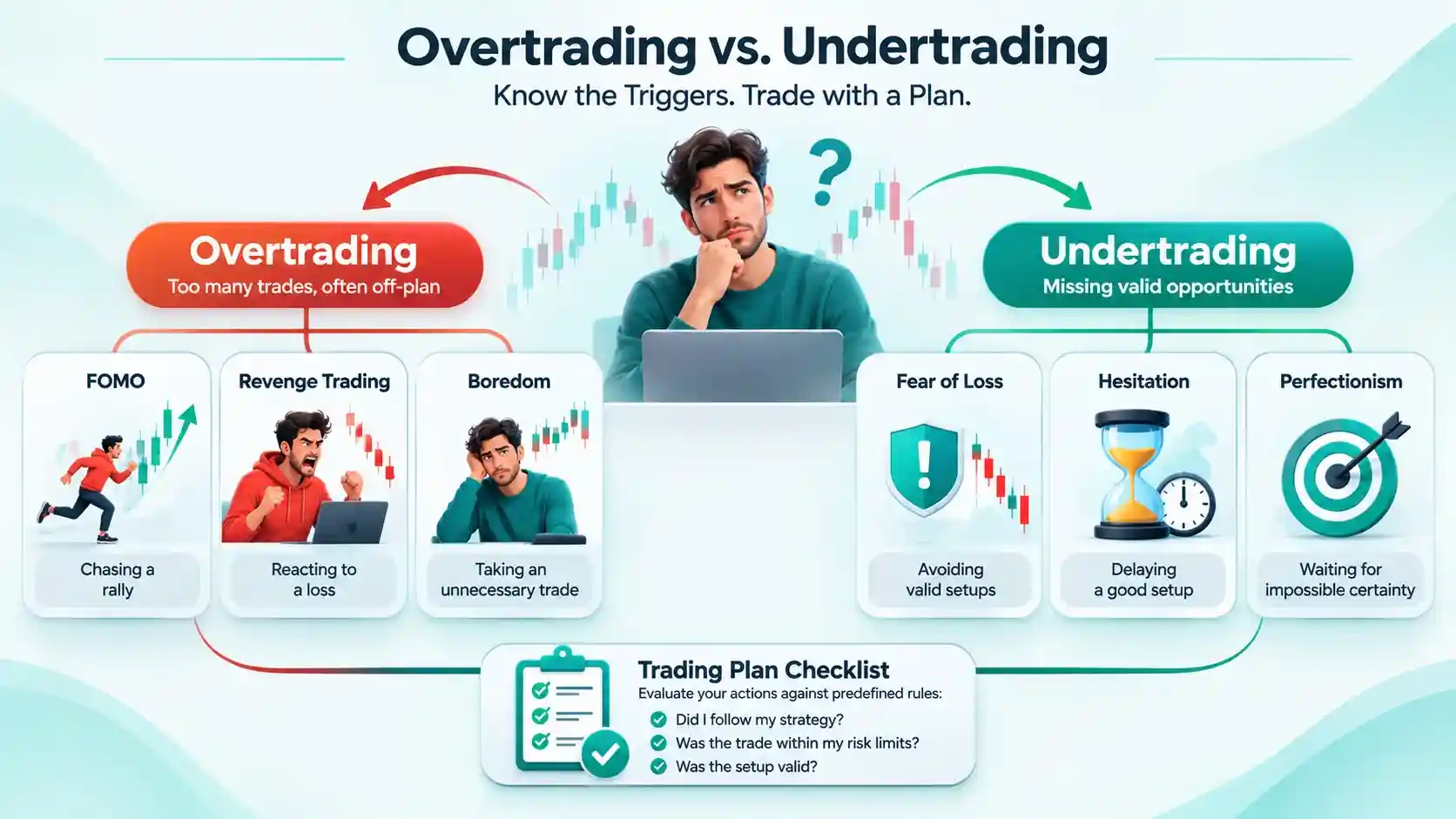
Overtrading occurs when a trader places trades or takes risks that are unnecessary, excessive, or inconsistent with their predefined strategy, account constraints, or risk-management rules.
It may involve:
- Entering positions without the required setup.
- Trading outside approved market sessions.
- Opening additional positions after reaching a risk limit.
- Increasing position size beyond the planned exposure.
- Taking revenge trades after losses.
- Repeatedly entering the market because waiting feels uncomfortable.
Overtrading is often described as taking too many trades. That description is incomplete because it ignores the strategy.
For example, a trader whose documented strategy generates ten eligible setups during a session may be justified in taking ten appropriately sized trades. Another trader who enters once without a valid setup may have made an unnecessary, off-plan trade despite the lower frequency.
Excessive position sizing deserves particular attention. A technically valid entry can still be an execution violation if the trader disregards the permitted risk.
What Is Undertrading?
Undertrading, in a self-directed trading psychology context, means repeatedly failing to execute otherwise eligible opportunities because of avoidable hesitation, fear, indecision, or inconsistent application of a trading plan.
Imagine a trader who has a clearly defined entry setup. The required technical conditions appear, risk limits permit a trade, and the trader is available to execute.
However, the trader repeatedly delays the entry while searching for additional confirmation that was never part of the strategy.
That behavior may represent undertrading.
But an important distinction applies: a technically attractive setup is not automatically an eligible trading opportunity.
If the trader has already reached a daily loss limit, is outside an approved trading session, or cannot meet the required risk conditions, skipping the setup may be correct.
Why These Definitions Matter
The purpose of identifying overtrading or undertrading is not to pressure yourself into trading more or less. It is to determine whether your actual execution is consistent with a defined and risk-aware process.
Core principle: Trade frequency is a measurement. Trading discipline is a judgment about whether your decisions followed appropriate rules. The two are related, but they are not interchangeable.
Terminology note: In corporate financial management, overtrading and undertrading can describe problems involving business activity and working capital. This article uses the terms only in the context of self-directed financial-market trading. For the broader definitions, see Capital.com's finance glossary.
Overtrading vs. Undertrading: Key Differences
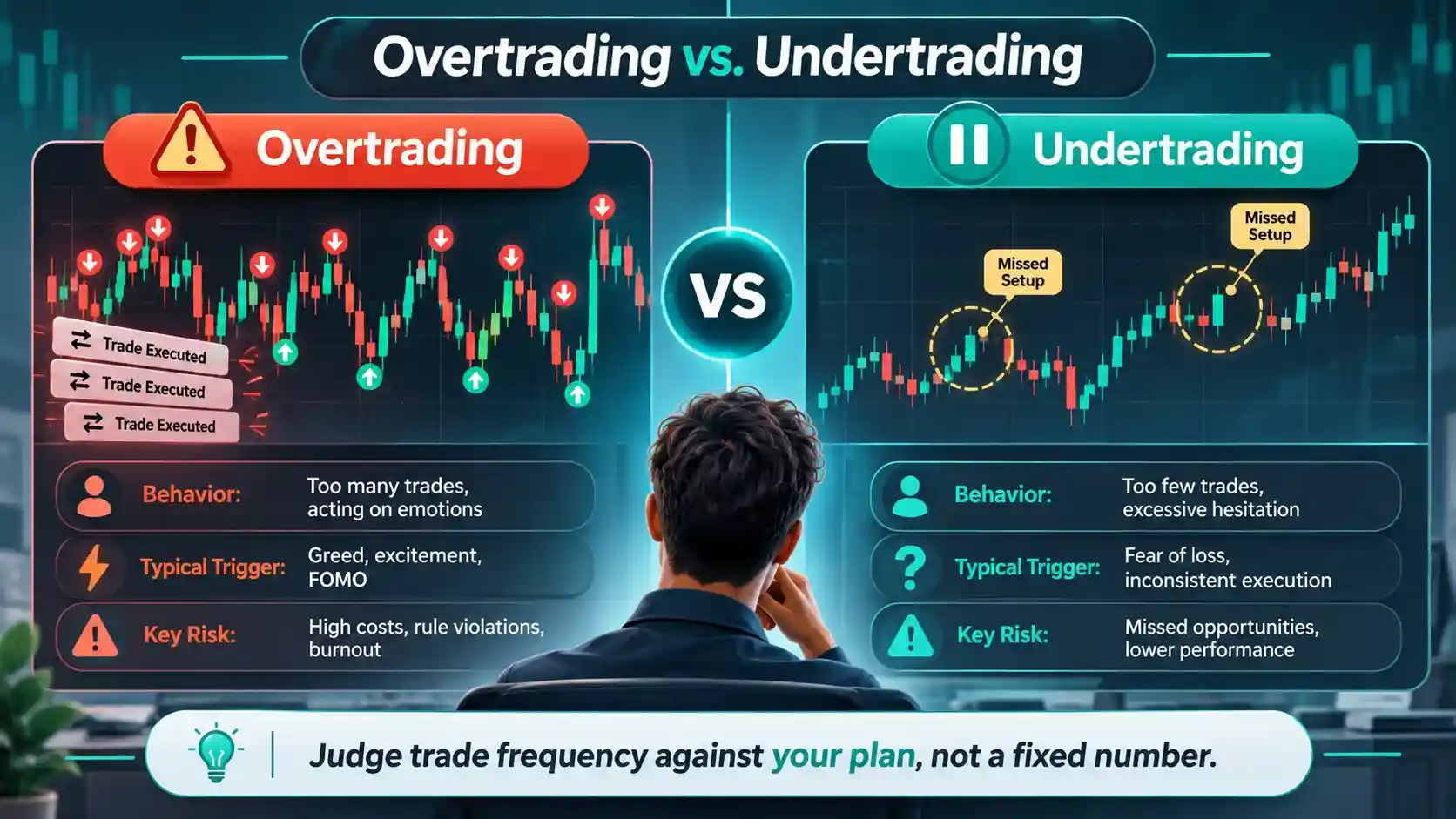
Both behaviors involve a mismatch between intended trading behavior and actual execution, but they appear in different ways.
| Factor | Overtrading | Undertrading |
|---|---|---|
| Primary behavior | Taking unnecessary or off-plan trades | Missing otherwise eligible trades without a valid reason |
| Typical decision problem | Acting when the plan says wait | Waiting when the plan permits action |
| Possible emotional influences | FOMO, boredom, frustration, overconfidence | Fear of loss, hesitation, perfectionism, self-doubt |
| Risk-related concern | Unnecessary exposure or rule violations | Inconsistent execution of an intended strategy |
| What a trade history may reveal | Unplanned entries, unusual frequency, excessive sizing | Usually insufficient evidence on its own |
| Additional evidence needed | Original rules and rationale for each executed trade | Records of valid but unexecuted opportunities |
| Practical first step | Identify the rules behind each executed trade | Identify and document genuinely eligible missed setups |
Can a Trader Be Both an Overtrader and an Undertrader?
Yes. The behaviors are not mutually exclusive.
A trader may avoid valid entries out of fear and later chase price movements that no longer satisfy the strategy.
In that situation, the trader has missed an eligible opportunity and taken an ineligible trade.
This is why overall trade count alone can be misleading. The number of executed positions may look perfectly normal even when the trader consistently makes the wrong execution decisions.
Later in this article, a numerical example demonstrates how both problems can exist in the same trading record.
Warning Signs and Behavioral Causes
Trading decisions can be influenced by emotion, habit, fatigue, strategy ambiguity, and market conditions. These influences should be investigated rather than treated as automatic diagnoses.
Common Signs of Overtrading
- You enter trades that cannot be matched to a predefined setup.
- Your position sizes increase after losses or winning streaks without a documented rule.
- You repeatedly trade outside your planned sessions.
- You continue trading after reaching a predefined stopping condition.
- You lower your entry standards as the session progresses.
- You struggle to explain why a particular trade was opened.
- You increasingly focus on recovering daily losses rather than evaluating setups.
These observations can indicate a process problem. They do not prove that every additional trade was unprofitable or that a specific emotion caused the behavior.
Common Signs of Undertrading
- You repeatedly recognize qualifying setups but fail to act despite meeting all entry and risk conditions.
- You require additional confirmation that your written strategy does not demand.
- You hesitate after a losing trade even when the next opportunity meets the same criteria.
- You frequently cancel otherwise valid orders without a documented reason.
- You review missed opportunities and discover repeated inconsistency in applying your own rules.
The word repeatedly matters. A single missed opportunity may result from distraction, connectivity problems, limited availability, or an unusual event. It does not establish a lasting behavioral pattern.
Possible Psychological Influences
Fear of Missing Out
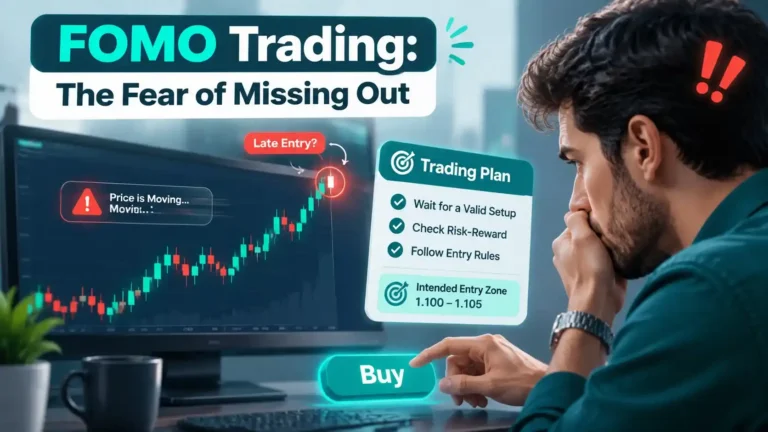
Seeing a market move without you can create an urge to enter after the original conditions have disappeared.
Review: Did the trade still meet your strategy when you entered?
Revenge Trading
After a loss, the goal may shift from executing a strategy to recovering money quickly.
Review: Was the next trade independently justified before entry?
Boredom and Overconfidence
Long periods of waiting or a recent winning streak may encourage unnecessary activity or larger-than-planned exposure.
Review: Did your entry criteria or risk limits change without a planned reason?
Fear of Losing
A trader may avoid eligible setups after experiencing losses, even when the predefined risk remains acceptable.
Review: Was the setup eligible, and did a valid restriction prevent execution?
Excessive Hesitation
Repeatedly second-guessing an established entry process can cause opportunities to expire.
Review: Did you delay because of new market information or because of an unplanned demand for certainty?
Perfectionism
A trader may wait for ideal conditions that go beyond the actual strategy, effectively changing the rules during execution.
Review: Were the required conditions documented before the session?
What Research Can—and Cannot—Tell Us
In a study of retail Forex trading, researchers Itzhak Ben-David, Justin Birru, and Viktor Prokopenya documented evidence consistent with traders increasing risk-taking after favorable trading feedback, even though earlier performance did not predict subsequent success in their sample.
The study examined behavioral responses within its research data. It does not mean every trader becomes overconfident after a profit, nor does it establish that a particular individual is overtrading.
Source: Uninformative Feedback and Risk Taking: Evidence from Retail Forex Trading, NBER Working Paper 22146, published in 2016 and subsequently published in Review of Finance.
The practical lesson is to compare behavior against predefined rules instead of assuming that recent gains or losses accurately measure decision quality.
When Not Trading Is the Right Decision
One of the most damaging misconceptions about undertrading is that every missed market move represents a mistake.
It does not.
A trading opportunity should be considered eligible only when all relevant requirements are satisfied, including entry conditions, session rules, risk limits, and the trader's ability to execute appropriately.
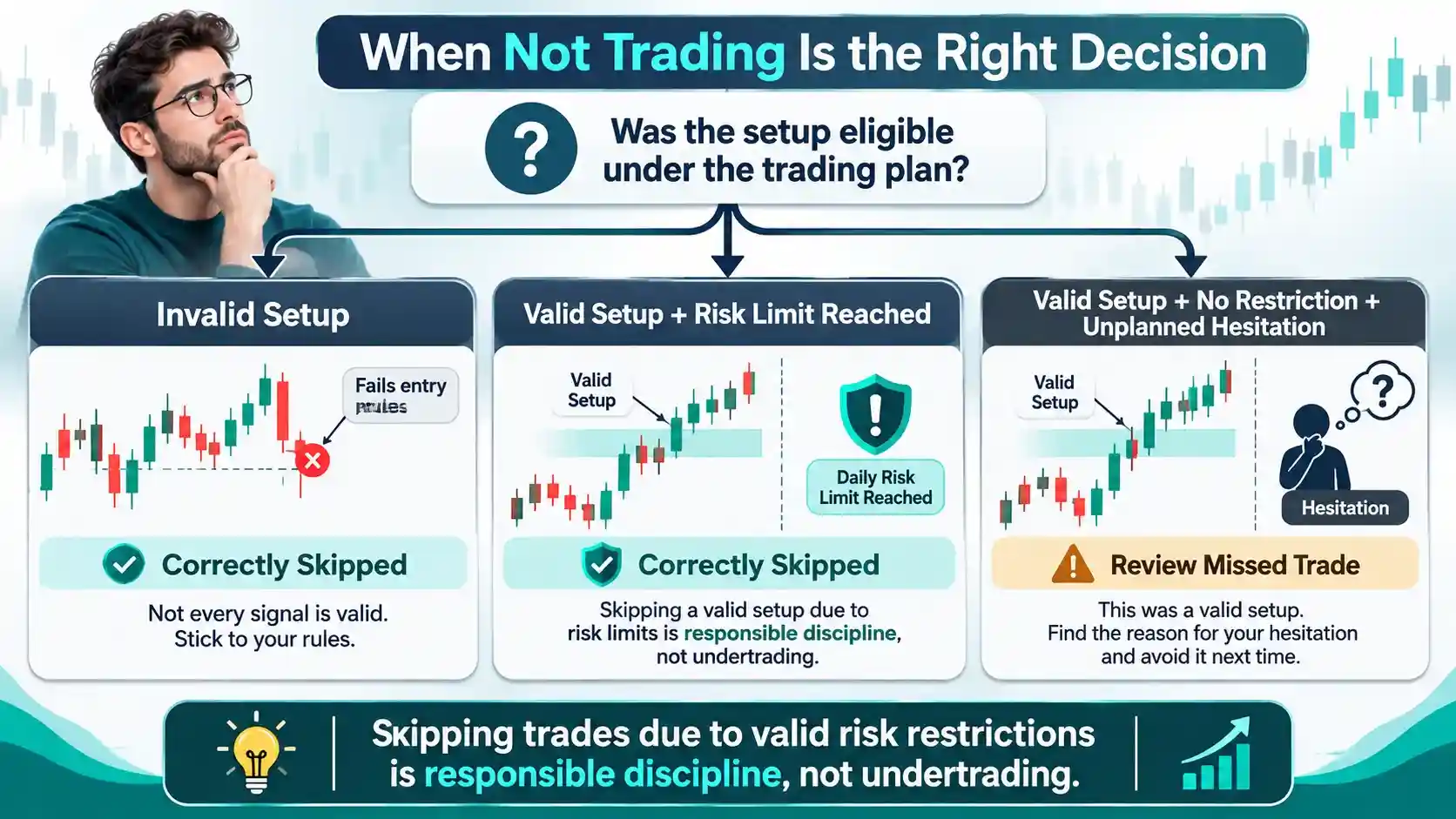
Three Different No-Trade Situations
Invalid Setup, Correctly Skipped
A price movement looks attractive, but the required confirmation never appears.
Skipping it is consistent with the trading plan.
Valid Signal, Risk Restriction Active
The technical pattern qualifies, but the daily loss limit has been reached or the permitted exposure is unavailable.
The setup is not currently eligible for execution. Skipping it is responsible risk management.
Eligible Setup, Unplanned Hesitation
All technical, timing, and risk requirements are met, yet the trader delays without a plan-based reason.
If this happens repeatedly, it may indicate undertrading.
No Eligible Setups Appeared
The trader monitored the planned session, but no opportunity met the strategy's complete conditions.
Zero executed trades can be exactly the intended outcome.
Important: A trade that later becomes profitable was not necessarily valid when the opportunity appeared. You must evaluate its eligibility using information and rules available at the decision point, not the outcome visible afterward.
How to Detect Overtrading and Undertrading with a Trade Execution Gap Audit
Most trading platforms can show how many positions you opened, when they were executed, and what their financial results were.
But the execution history usually cannot show every trading opportunity that you identified and deliberately skipped or unintentionally missed.
That missing information creates an important measurement problem:
You cannot reliably identify undertrading from completed trades alone.
The Trade Execution Gap Audit is a practical educational framework for comparing eligible trading opportunities with actual execution. It combines a trade record with an opportunity log.
Its purpose is not to produce a medical or psychological diagnosis. It is to make specific execution gaps visible and reviewable.
First, Define an Eligible Setup
For this framework, an eligible setup must pass two separate checks:
- Technical qualification: The market meets the strategy's predefined entry criteria.
- Permission to execute: The trade also meets session limits, risk limits, available exposure, and any other binding restrictions.
A setup that passes the first check but fails the second is not counted as an eligible executable opportunity.
This distinction prevents responsible risk management from being mislabeled as undertrading.
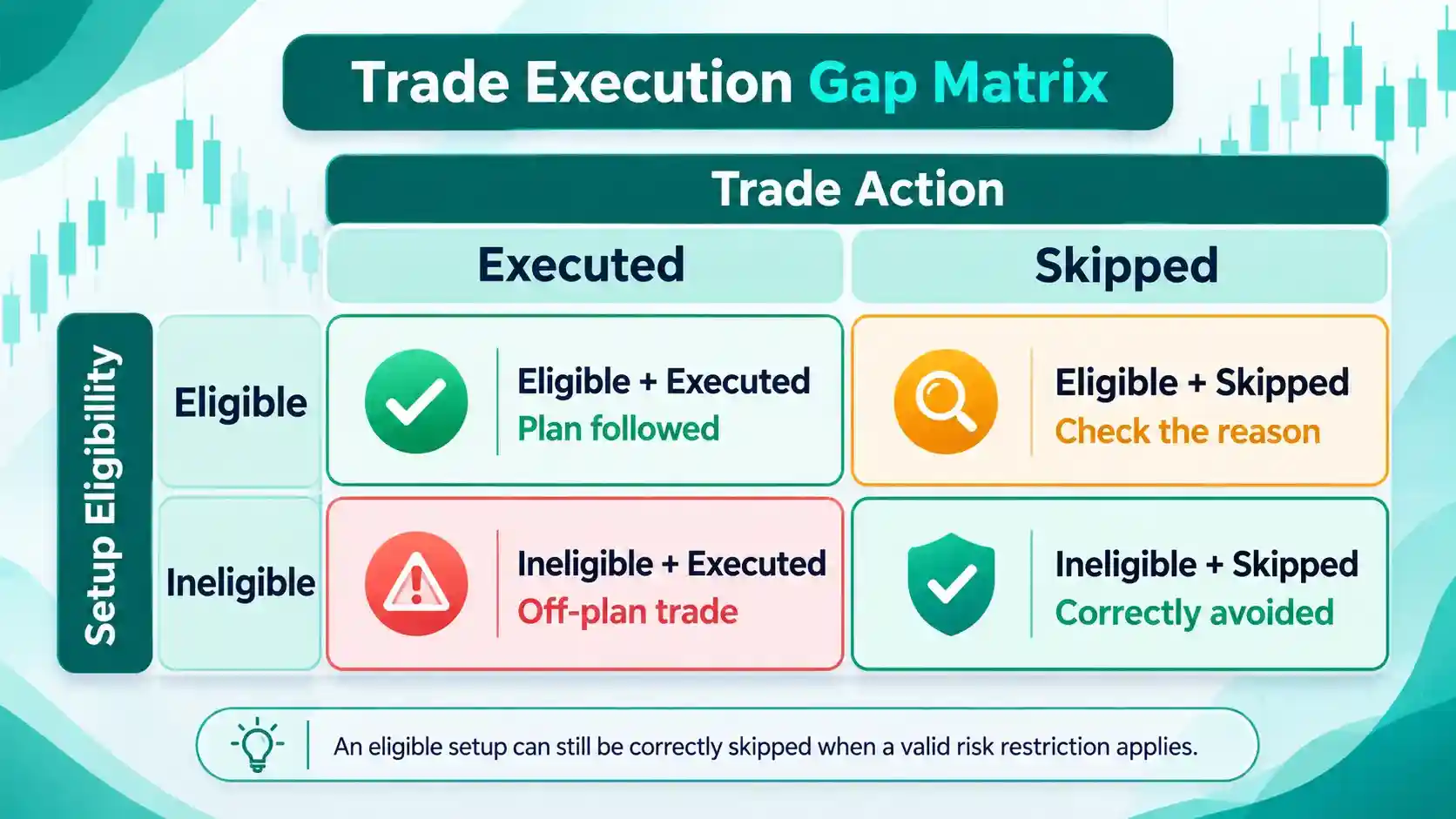
The Four-Case Execution Matrix
| Opportunity Classification | Executed | Skipped |
|---|---|---|
| Eligible under the complete plan |
Case 1: Planned Execution Eligible setup executed according to plan. |
Case 2: Review the Miss Determine whether a valid reason existed. An unjustified, repeated miss may indicate undertrading. |
| Ineligible under the complete plan |
Case 3: Off-Plan Execution An unqualified or restricted trade was placed. Investigate the rule breach. |
Case 4: Correct Avoidance The opportunity was appropriately skipped. |
In the second case, a skipped eligible setup is not automatically evidence of a psychological problem. The reason must be investigated, and patterns should be evaluated over multiple comparable opportunities.
In the third case, an entry may match the technical pattern but still be off-plan if the trader breaks a binding position-sizing, risk, or session restriction.
The Extra Check: Was the Executed Trade Properly Sized?
The matrix is useful, but it should not replace a risk-compliance review.
A trader can recognize a valid setup and still take too much risk.
Therefore, every executed trade should also be checked against the planned position size, stop-loss rules, total exposure, and session restrictions.
An otherwise valid signal executed with a serious rule violation should be flagged as off-plan for the behavioral review. Do not classify it as fully compliant just because the entry signal was present.
A Realistic 12-Trade Example: Two Problems Hidden in One Record
Consider a fictional Forex trader who follows a predefined trend-pullback strategy over four trading sessions.
The trader records every opportunity that satisfies the complete strategy and risk requirements, whether or not it leads to an executed position.
The following numbers are entirely hypothetical. They illustrate the audit method, not actual performance results from Jornilo or any trader.
The Trading Activity Summary
| Session | Eligible Setups | Eligible Executed | Eligible Missed | Off-Plan Executed | All Executed |
|---|---|---|---|---|---|
| Session 1 | 3 | 2 | 1 | 1 | 3 |
| Session 2 | 2 | 1 | 1 | 1 | 2 |
| Session 3 | 4 | 3 | 1 | 1 | 4 |
| Session 4 | 3 | 2 | 1 | 1 | 3 |
| Total | 12 | 8 | 4 | 4 | 12 |
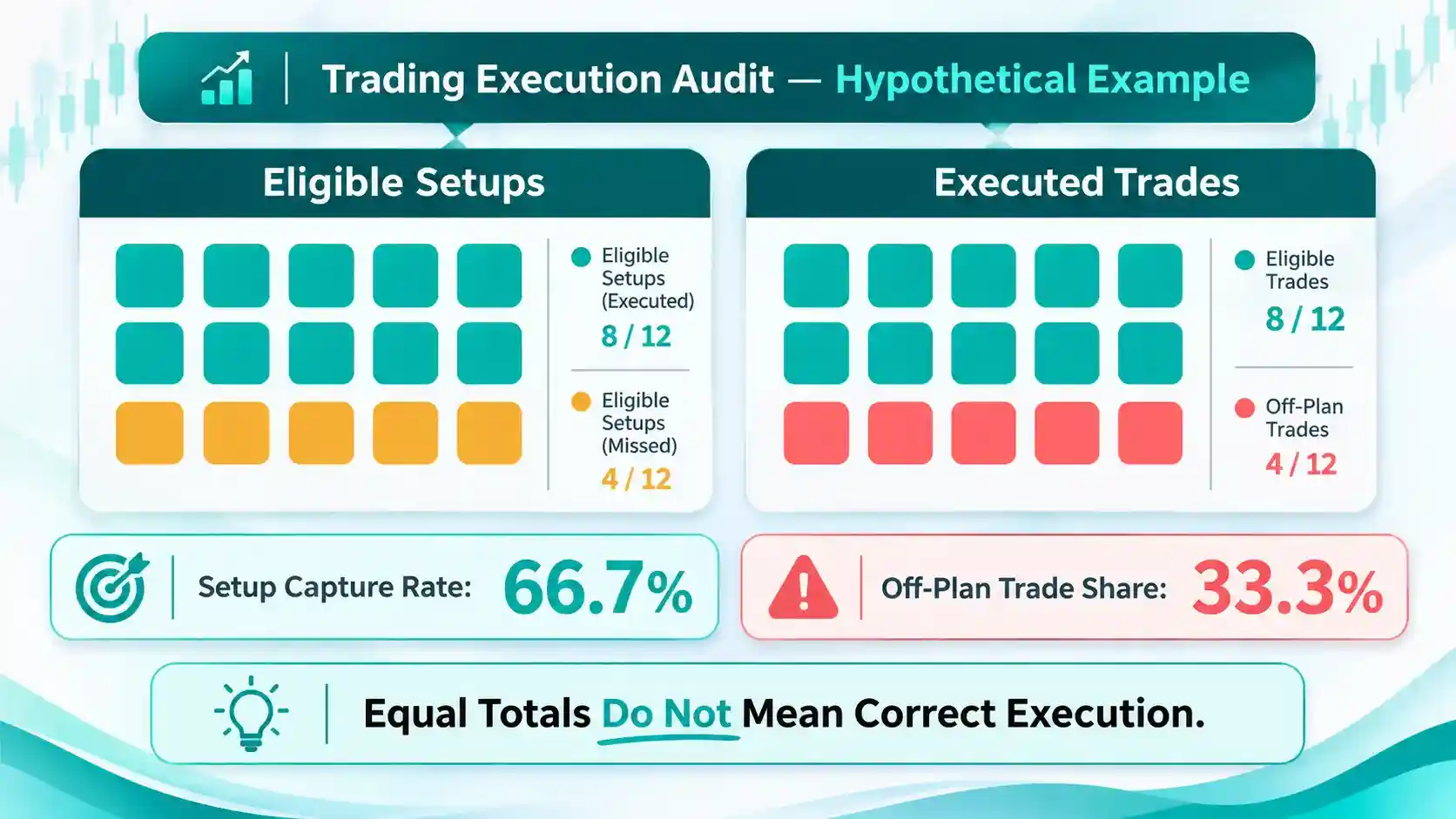
At first glance, the account history looks ordinary: 12 trades were completed, and 12 valid opportunities appeared.
But the equality of those totals hides an important distinction.
Only eight of the 12 eligible setups were actually executed. The trader missed four eligible opportunities and also entered four positions that did not satisfy the plan.
How the Two Audit Metrics Are Calculated
In this example:
This means approximately two-thirds of the eligible opportunities were executed.
In this example:
This means approximately one-third of executed positions violated the predefined plan.
These are descriptive educational metrics. Neither percentage is a validated diagnostic threshold, a target for all strategies, or evidence of future profitability.
What Happened to the Four Missed Setups?
Counts alone are not enough. To determine what the numbers mean, the trader must review the reasons behind each missed opportunity.
| Session | Recorded Reason | Review Observation |
|---|---|---|
| 1 | Waited for extra confirmation not required by the strategy | Review whether the additional condition was introduced after the setup appeared. |
| 2 | Hesitated after the previous losing position | Check whether any actual risk restriction or new market information justified the delay. |
| 3 | Repeatedly reconsidered the entry despite the checklist being satisfied | Compare the original entry rules with the criteria applied during execution. |
| 4 | Delayed an eligible order without documenting a new reason | Investigate execution process and availability before attributing the miss to emotion. |
For this fictional audit, assume all four opportunities met the complete requirements at the time they appeared, the trader could reasonably have executed, and no binding risk restriction applied.
Those assumptions are essential. Without them, the four missed opportunities should not automatically be counted as avoidable undertrading.
What Happened to the Four Off-Plan Trades?
The four additional trades were documented as:
- A chase entry after the planned entry window had passed.
- An entry made without the required confirmation.
- A trade taken outside the permitted session.
- A position opened after a binding risk limit had been reached.
These are examples of execution violations. Their financial results do not determine whether they were valid.
An off-plan trade can be profitable. An eligible trade can lose money. Neither outcome changes the original classification.
The hidden insight: The trader did not simply trade too much or too little. They executed the wrong mix of opportunities. Four eligible setups were missed while four unplanned trades were taken. A trade-count-only review would fail to show this distinction.
What Can We Conclude from the Example?
We can identify two execution gaps worth investigating: the share of documented eligible setups that were missed and the share of executed trades that broke the plan.
We cannot conclude that the four missed trades would have been profitable. We also cannot conclude that correcting these behaviors would necessarily improve returns.
Twelve opportunities represent a small sample. The observations should guide further data collection and process review rather than support sweeping conclusions.
How to Run Your Own Trade Execution Gap Audit
You do not need a complicated analytical system to begin. You need clear trading rules, an accurate execution history, and a way to document opportunities that were not executed.
-
Write Down the Rules Before the Session
Define the required setup, confirmation conditions, session window, maximum permitted risk, position-sizing rules, and stopping conditions. Avoid rewriting the requirements after you know the market outcome.
-
Identify Opportunities Without Using Future Results
Record whether a setup qualifies when the relevant information becomes available. If possible, capture the timestamp, instrument, and chart context at the decision point.
-
Apply the Risk and Permission Check
Confirm that the opportunity is actually executable under the full plan. A technically valid setup blocked by a risk limit must not be counted as an eligible missed trade.
-
Match Executed Trades to Planned Opportunities
For each completed position, record the corresponding strategy setup and whether the execution followed the rules. Separately flag any trade with an invalid setup or risk-rule violation.
-
Document Eligible Opportunities That Were Not Executed
Record the reason for skipping or missing each eligible setup. Distinguish hesitation from connectivity issues, unavailability, changing market conditions, and legitimate restrictions.
-
Review Patterns, Not Just Percentages
Calculate the two audit metrics, then examine individual decisions and recurring conditions. Look for patterns across comparable sessions before deciding whether your execution process needs adjustment.
The Minimum Information to Record
| Field | What to Record | Why It Matters |
|---|---|---|
| Timestamp and instrument | When and where the setup appeared | Allows review against sessions and market context |
| Strategy and setup | The predefined pattern and required confirmation | Shows which rules should apply |
| Eligibility | Whether both strategy and execution restrictions were satisfied | Prevents misleading missed-trade counts |
| Execution status | Executed or skipped | Identifies the action taken |
| Risk compliance | Whether sizing and other risk rules were followed | Detects off-plan execution beyond entry signals |
| Reason for decision | The actual reason for entering or skipping | Provides context instead of assumptions |
| Evidence | Contemporaneous note, screenshot, or other available record | Reduces reliance on hindsight |
| Review observation | Specific question or possible process issue | Supports focused follow-up |
How to Record Opportunities That Never Became Trades
This is an important limitation of ordinary transaction histories.
A broker statement typically records executed activity. It does not automatically tell you which valid opportunities you observed but did not trade.
If your trading journal or platform cannot store unexecuted opportunities, maintain a separate opportunity record using a method that is practical for your workflow.
The objective is to preserve a reliable decision record, not to force every missed setup into the completed-trades list or invent an execution that never happened.
Protect the Audit Against Hindsight Bias
The quality of an audit depends on how opportunities are identified.
An opportunity recorded during the session is generally more useful for evaluating the original decision than one reconstructed later after seeing the price movement.
When reviewing past charts, distinguish between:
- Contemporaneously documented opportunities: Setups recorded when the relevant decision was possible.
- Reconstructed opportunities: Setups identified later using historical charts.
- Uncertain opportunities: Cases where the original rules or execution conditions cannot be reliably established.
Avoid mixing these evidence categories without qualification. Reconstructed setups can help explore strategy behavior, but they are weaker evidence for claiming a trader consciously missed a valid entry.
The Hidden Costs of Overtrading
Unnecessary trades can create costs and exposure even when some of those trades finish with a profit.
Transaction Costs Can Accumulate
Depending on the instrument and broker, trading costs may include spreads, commissions, exchange or clearing fees, slippage, and financing charges.
Costs must be calculated according to the actual account and instrument. In particular, spread costs and commissions should not be counted twice when reviewing a result that already includes them.
A Simple Hypothetical Cost Example
Imagine that the four off-plan trades from the earlier example each incurred a separate $4 round-trip commission.
The $16 figure is illustrative. It does not include any additional spread impact, slippage, financing, or financial gain or loss from the trades themselves.
If the trades had not been placed, those illustrative commissions would not have been incurred. However, that does not prove the account's overall profit would necessarily have been higher, because the trades could also have generated gains or losses.
Risk Exposure Matters More Than Trade Count Alone
Overtrading can also involve excessive position size or overlapping exposure.
For example, multiple currency positions may be exposed to related market movements. Treating them as independent opportunities can underestimate the combined risk.
This is one reason that monitoring trade frequency alone is insufficient. A complete review should examine individual position risk, total open exposure, and whether the trader followed the intended limits.
The U.S. Commodity Futures Trading Commission discusses costs, dealer relationships, and risks associated with over-the-counter retail Forex trading in its Forex customer advisory.
How to Correct Overtrading and Undertrading
There is no universal number of trades that every trader should aim to take.
A scalping strategy may generate many legitimate opportunities during one session, while a swing-trading strategy may produce only a few eligible setups across several weeks.
The goal is to improve consistency relative to the strategy, not to force activity toward an arbitrary target.
Practical Safeguards Against Overtrading
- Define entry conditions clearly. Use criteria that can be checked before placing an order.
- Set risk boundaries. Specify permitted position sizing, maximum exposure, and stopping conditions consistent with your trading approach.
- Identify off-plan trades. Require a documented setup and reason for each execution.
- Watch changes after wins and losses. Review whether recent results coincide with larger positions or looser entry standards.
- Use planned breaks where useful. A pause may help interrupt impulsive decisions, but it should not be treated as a guarantee of better outcomes.
- Review trading costs. Examine whether unnecessary activity creates avoidable commissions and other expenses.
Practical Safeguards Against Undertrading
- Make eligibility unambiguous. Separate required conditions from optional preferences.
- Prepare decisions before the setup appears. Define acceptable risk and execution procedures in advance.
- Record missed opportunities accurately. Capture the actual reason for not entering.
- Distinguish fear from valid restrictions. A missed trade after a risk limit is reached is not an execution failure.
- Review repeated hesitation. Investigate whether extra confirmation is being added inconsistently.
- Test process changes cautiously. Practice or simulated environments can be useful when reviewing execution procedures without immediately increasing live risk.
Before-Session Checklist
Five Questions Before You Start
- Which strategy and setups am I permitted to trade today?
- What market sessions and conditions are included or excluded?
- What are my current risk, exposure, and stopping limits?
- What evidence will I record for eligible opportunities?
- What will I do if I feel tempted to change the rules during execution?
After-Session Review Checklist
Five Questions After You Finish
- How many fully eligible opportunities did I document?
- How many were executed according to plan?
- Which eligible opportunities were skipped, and why?
- Which executed trades violated a predefined rule?
- What is one specific execution issue worth observing in the next comparable session?
Avoid the Opposite Overcorrection
After recognizing overtrading, some traders may respond by avoiding nearly every opportunity.
Likewise, after identifying possible undertrading, a trader might start forcing entries simply to increase activity.
Neither reaction addresses the underlying problem.
The appropriate correction is to clarify the strategy, improve execution consistency, and respect risk limits.
Better process goal: Execute eligible opportunities according to a risk-aware plan, and avoid ineligible trades. Do not make "more trades" or "fewer trades" the primary definition of success.
How a Trading Journal Helps Identify Execution Gaps
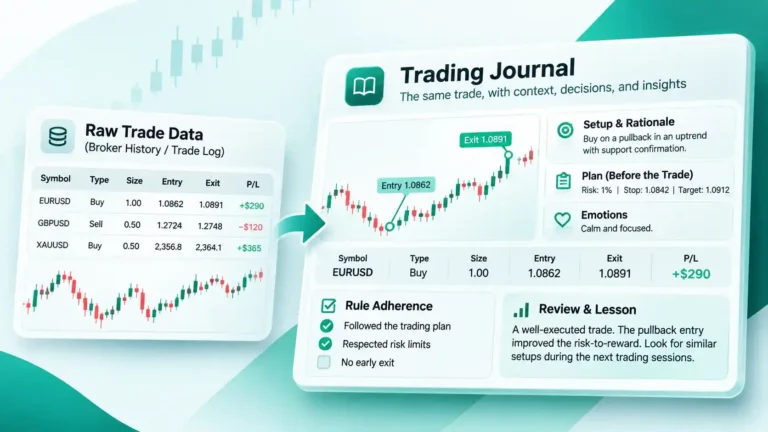
A trading journal can connect individual transactions with their decision context.
It can help you investigate whether an executed trade matched the strategy, whether sizing respected the plan, and whether repeated behavior changes appear after winning or losing sessions.
However, an ordinary trade record has an important limitation: it does not automatically contain every eligible opportunity that was never executed.
For a complete overtrading-and-undertrading review, you may need to combine executed-trade records with separately documented opportunity observations.
What to Look for in Your Trading Records
| Question | Useful Evidence | Possible Finding |
|---|---|---|
| Were entries supported by valid setups? | Setup tags, entry reasons, chart context | Off-plan executions |
| Were position sizes consistent with the plan? | Planned risk, actual size, stop placement | Exposure or sizing violations |
| Did trading behavior change after losses? | Trade sequence, risk changes, decision notes | A possible behavior pattern requiring further review |
| Were eligible setups repeatedly missed? | Opportunity log, timestamps, eligibility checks | Possible undertrading or execution difficulty |
| Were no-trade decisions justified? | Session rules, risk limits, setup qualifications | Appropriate avoidance rather than undertrading |
If you are unfamiliar with the basic purpose of a journal, read What Is a Trading Journal?.
For a practical guide to documenting trades and reviewing them consistently, see How to Journal Trades.
The emphasis here is different: rather than explaining how to create a journal, the goal is to use trading records to investigate the gap between opportunities and decisions.
Limitations, Misinterpretations, and Common Mistakes
The Trade Execution Gap Audit is a structured way to organize observations, not a scientifically validated diagnostic instrument.
Its findings depend on the quality of the underlying records and the trading rules used for comparison.
1. Counting Opportunities After the Outcome Is Known
Reviewing a chart after a strong price move can make an entry look more obvious than it was in real time.
To reduce this problem, record opportunities and qualification criteria as close to the decision point as practical.
2. Treating Every Missed Setup as Lost Profit
A missed eligible entry may have produced a gain, a loss, or a different result under real execution conditions.
The purpose of the audit is to review process consistency, not to invent hypothetical profits from trades that never occurred.
3. Assuming One Ratio Fits Every Strategy
A 66.7% capture rate does not have a universal interpretation. Context matters: strategy design, sample quality, market conditions, and the reasons for missed executions all affect the meaning of the number.
4. Confusing Execution Discipline With Strategy Quality
Following a plan consistently does not prove that the strategy itself has a profitable edge.
A well-executed strategy can lose money. Execution quality and strategy effectiveness must be assessed separately.
5. Inferring Emotional Causes from Counts Alone
An increase in trading frequency after a loss is worth investigating, but it does not independently prove revenge trading.
Market conditions, planned strategy activity, or other factors may explain the change.
6. Ignoring Sample Size and Missing Data
A small number of opportunities can produce unstable percentages. If qualifying setups are not recorded consistently, the calculated capture rate may also be misleading.
There is no universal sample size that makes this audit conclusive for every strategy.
7. Confusing Self-Directed Overtrading With Broker Churning
Individual traders often use the word overtrading to describe excessive or unnecessary activity in their own accounts.
In securities regulation, churning has a more specific meaning involving broker conduct, excessive activity, and circumstances such as intent to defraud or reckless disregard for customer interests.
These concepts should not automatically be treated as legally interchangeable.
For an explanation of the regulatory distinction, see FINRA's guidance on excessive trading and churning.
Frequently Asked Questions
What is the difference between overtrading and undertrading?
Overtrading involves unnecessary, oversized, or off-plan trades. Undertrading involves repeatedly missing otherwise eligible trading opportunities without valid reasons. Both should be evaluated relative to a predefined strategy and risk limits, not solely by the number of trades.
How many trades per day is considered overtrading?
There is no universally correct number. A high-frequency strategy may legitimately generate many trades, while a slower strategy may produce only a few opportunities. Overtrading is better assessed through rule compliance, risk exposure, and the validity of executed setups.
Is taking no trades during a session undertrading?
Not necessarily. If no eligible setup appeared, or if binding risk restrictions prevented execution, taking no trades may be the correct decision. Undertrading requires evidence of otherwise eligible opportunities that were repeatedly missed without a valid reason.
Can you overtrade and undertrade at the same time?
Yes. A trader can miss eligible setups and still take unnecessary trades outside the plan. Comparing documented opportunities with actual executions can reveal both behaviors in the same period.
What causes undertrading?
Possible influences include fear of loss, excessive hesitation, self-doubt, and requiring confirmation beyond the predefined strategy. However, missed entries may also result from legitimate restrictions or practical execution problems, so the reason should be documented rather than assumed.
Can a trading journal detect undertrading automatically?
A journal containing only executed trades generally cannot identify all missed valid opportunities. Undertrading analysis requires reliable information about setups that appeared but were not executed. Whether software supports recording or analyzing those opportunities depends on its actual features.
Does reducing overtrading guarantee higher profits?
No. Reducing unnecessary activity may eliminate certain costs or risk violations, but profitability also depends on strategy quality, market conditions, execution, and other factors. A disciplined process does not guarantee positive returns.
What is the difference between overtrading and churning?
Self-directed overtrading usually refers to excessive or unnecessary trading decisions made by the trader. Churning can refer to a specific form of broker misconduct involving excessive trading and additional regulatory elements. The terms should not automatically be used as legal synonyms.
Do overtrading and undertrading have another meaning in finance?
Yes. In corporate financial management, the terms can describe operating activity that exceeds or falls below what a company's working capital and resources can appropriately support. That meaning is different from the trading-psychology context explained here.
Final Thoughts: Trade According to Your Plan, Not Your Urges
Overtrading and undertrading are often presented as opposite problems: trading too much and trading too little.
A more useful interpretation focuses on execution quality.
Overtrading is a concern when unnecessary or noncompliant trades are placed. Undertrading becomes a concern when genuinely eligible opportunities are repeatedly missed without a valid reason.
Neither behavior can be evaluated accurately using trade count alone.
The Trade Execution Gap Audit offers a practical way to examine both sides of the problem. By comparing eligible opportunities, executed trades, missed setups, and rule violations, you can identify specific questions that deserve further review.
You do not need to trade more to prove that you are disciplined. You do not need to trade less to prove that you are cautious.
The goal is to follow a clearly defined, risk-aware process and gather reliable evidence about how consistently you apply it.
Educational Disclaimer: This content is for general education only and does not constitute personalized investment, trading, legal, or financial advice. All audit data, session records, costs, and examples are hypothetical unless explicitly identified as published research. The Trade Execution Gap Audit is an illustrative review framework, not a validated psychological test or a guarantee of improved returns. Trading Forex, CFDs, Futures, and other leveraged instruments involves significant risk of financial loss. Past performance and hypothetical examples do not predict future results.